Monographs: Pharmaceutical substances: Dactinomycin (Dactinomycinum)
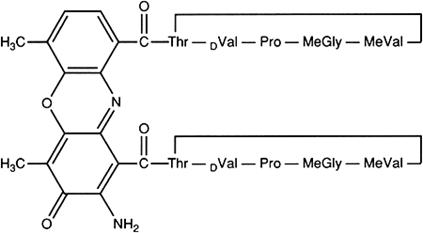
C62H86N12O16
Relative molecular mass. 1255
Chemical name. Actinomycin D; CAS Reg. No. 50-76-0.
Description. An orange-red to red, crystalline powder.
Solubility. Soluble in water at 10 °C and slightly soluble in water at 37 °C; freely soluble in ethanol (~750 g/l) TS and methanol R; very slightly soluble in ether R.
Category. Cytotoxic drug.
Storage. Dactinomycin should be kept in a tightly closed container, protected from light, and stored at a temperature not exceeding 40 °C.
Additional information. Dactinomycin is hygroscopic and is affected by light and heat.
CAUTION. Dactinomycin must be handled with care, avoiding contact with the skin and inhalation of airborne particles.
Requirements
Dactinomycin contains not less than 95.0% and not more than the equivalent of 103.0% of C62H86N12O16, calculated with reference to the dried substance.
Identity tests
A. The absorption spectrum of a 25 μg/mL solution in methanol R, when observed between 220 nm and 500 nm, exhibits 2 maxima at about 240 nm and 445 nm. The absorbance of a 1-cm layer at the maximum wavelength of 445 nm is about 0.83; the ratio of the absorbance at 240 nm to that at 445 nm is between 1.30 and 1.50.
B. Carry out the test as described under 1.14.1 Chromatography, Thin-layer chromatography, using silica gel R4 as the coating substance and a mixture of 4 volumes of 1-butanol R, 2 volumes of water, and 1 volume of methanol R as the mobile phase. Apply separately to the plate 10 μl of each of two solutions in acetone R containing (A) 10 mg of Dactinomycin per mL and (B) 10 mg of dactinomycin RS per mL. After removing the plate from the chromatographic chamber, allow it to dry in air, and examine the chromatogram in ultraviolet light (254 nm).
The principal spot obtained with solution A corresponds in position, appearance, and intensity with that obtained with solution B.
C. Add 1 mg to a solution of 10 mg of paraformaldehyde R in 1 mL of sulfuric acid (~1760 g/l) TS; a red-violet colour is produced.
Melting range. 235-237 °C.
Specific optical rotation. Use a 1.0 mg/mL solution in methanol R and calculate with reference to the dried substance; = -292° to -317°.
Sulfated ash. Not more than 5.0 mg/g.
Loss on drying. Dry at 60 °C under reduced pressure (not exceeding 0.6 kPa or 5 mm of mercury) for 3 hours; it loses not more than 50 mg/g.
pH value. pH of a saturated solution, 5.5-7.0.
Assay. Carry out the test as described under 1.14.1 Chromatography, High-performance liquid chromatography, using a column, length 30 cm, internal diameter 3.9 mm, packed with porous silica gel or ceramic microparticles having a diameter of 5-10 μm, the surface of which has been modified with chemically bonded octadecylsilyl groups.
As the mobile phase, use a mixture of 46 volumes of acetonitrile R, 25 volumes of sodium acetate (0.04 mol/l) VS and 25 volumes of acetic acid (0.07 mol/l) VS, filter through a membrane filter (porosity of 1 μm or finer) and degas the resulting solvent mixture. (Note: The concentration of acetonitrile may have to be adjusted to provide a suitable chromatogram and elution time.)
Prepare the following solutions immediately before use in the above-mentioned mobile phase, and store them protected from light. Weigh accurately for solution (A) about 1.2 mg of Dactinomycin per mL, and for solution (B) about 1.2 mg of dactinomycin RS per mL.
Operate with a flow rate of 1.0 mL per minute. As a detector use an ultraviolet spectrophotometer at a wavelength of about 254 nm. Make three replicate injections of solution B, each of 20 μl, to determine the peak responses. The relative standard deviation of the peaks is not more than 1.0%. Inject 20 μl of each of solutions A and B.
Measure the areas of the peak responses. (The retention time for dactinomycin is about 25 minutes.) Calculate the content in % of C62H86N12O16 using the following formula: (M2/M1) (A1/A2) 100, in which M1 and M2 are the concentrations , in mg per mL, of Dactinomycin being examined and the reference solution, and A1 and A2 are the areas of the peak responses of Dactinomycin and the reference substance, respectively.
Additional requirements for Dactinomycin for parenteral use
Complies with the monograph for "Parenteral preparations".
Bacterial endotoxins. Carry out the test as described under 3.4 Test for bacterial endotoxins; contains not more than 100.0 IU of endotoxin RS per mg.
Sterility. Complies with 3.2 Test for sterility.
 |  |