Monographs: Pharmaceutical substances: Diluted Isosorbide dinitrate (Isosorbidi dinitras dilutus)
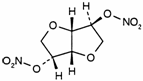
C6H8N2O8
CAUTION: To permit safe handling, Isosorbide dinitrate is mixed with a suitable inert diluent, such as lactose or mannitol.
Appropriate precautions in handling undiluted Isosorbide dinitrate need to be observed, since it can explode if subjected to percussion or excessive heat. Only exceedingly small amounts should be isolated.
Relative molecular mass. 236.1
Chemical name. 1,4: 3,6-Dianhydrosorbitol 2,5-dinitrate; CAS Reg. No. 87-33-2.
Description. Undiluted Isosorbide dinitrate is a fine, white, crystalline powder.
Solubility. Undiluted Isosorbide dinitrate is very slightly soluble in water; sparingly soluble in ethanol (~750 g/l) TS; very soluble in acetone R; freely soluble in dichloromethane R.
The solubility of the diluted product depends on the diluent and its concentration.
Category. Antianginal drug.
Storage. Diluted Isosorbide dinitrate should be kept in a tightly closed container, protected from light.
Labelling. The designation on the container should state the percentage content of Isosorbide dinitrate, C6H8N2O8.
Additional information. Diluted Isosorbide dinitrate may contain a suitable stabilizer, such as up to 1% of ammonium phosphate.
Requirements
Diluted Isosorbide dinitrate contains not less than 95.0% and not more than 105.0% of the amount of C6H8N2O8 stated on the label. It usually contains 20-50% of Isosorbide dinitrate.
Identity tests
A. Carry out the examination as described under 1.7 Spectrophotometry in the infrared region. The infrared absorption spectrum is concordant with the reference spectrum of isosorbide dinitrate. (Instructions for the preparation of the spectrum will be given on the reference spectrum.)
B. Dissolve in a test-tube a quantity equivalent to 10mg of Isosorbide dinitrate in a mixture of 1.0 mL of water and about 2.0 mL of sulfuric acid (~1760 g/l) TS and cool. Introduce slowly 3.0 mL of ferrous sulfate (15 g/l) TS to form two layers; a brown colour is formed at the interface of the two liquids.
C. Shake a quantity equivalent to 25 mg of Isosorbide dinitrate with 10 mL of acetone R and filter. Evaporate the filtrate to dryness at a temperature not exceeding 40 °C and dry the residue under reduced pressure (not exceeding 0.6 kPa or about 5 mm of mercury) over phosphorus pentoxide R for 16 hours; melting point of the residue, about 71 °C.
Heavy metals. Use 1.0 g for the preparation of the test solution as described under 2.2.3 Limit test for heavy metals, Procedure 3; determine the heavy metals content according to Method B; not more than 10 μg/g.
Loss on drying. Dry at ambient temperature under reduced pressure (not exceeding 0.6 kPa or about 5 mm of mercury) over phosphorus pentoxide R for 16 hours; it loses not more than 10 mg/g.
Inorganic nitrates. Carry out the test as described under 1.14.1 Chromatography, Thin-layer chromatography, using silica gel R3 as the coating substance and a mixture of 6 volumes of toluene R, 3 volumes of ethyl acetate R, and 1.5 volumes of glacial acetic acid R as the mobile phase. Apply separately to the plate 5ml of each of the two following solutions. For solution (A) shake a quantity equivalent to 0.10 g of Isosorbide dinitrate in 5 mL of ethanol (~750 g/l) TS and filter. Solution (B) must be freshly prepared by dissolving 10 mg of potassium nitrate R in 1 mL of water and diluting to 100 mL with ethanol (~750 g/l) TS. After removing the plate from the chromatographic chamber, dry it in a current of air, and spray with freshly prepared potassium iodide/starch TS1. Expose the plate to ultraviolet light for 15 minutes. Examine the chromatogram in daylight.
Any spot corresponding to the nitrate ion obtained with solution A is not more intense than that obtained with solution B (0.5%, calculated as potassium nitrate).
Related substances. Carry out the test as described under 1.14.1 Chromatography, Thin-layer chromatography, using silica gel R1 as the coating substance and a mixture of 8 volumes of toluene R and 2 volumes of ethyl acetate R as the mobile phase. Apply separately to the plate 20μl of each of the following 2 solutions. For solution (A) shake a quantity equivalent to 0.20 g of Isosorbide dinitrate with 5ml of acetone R and filter. For solution (B) dilute 1 volume of solution A to 200 volumes with acetone R. After removing the plate from the chromatographic chamber, dry it in a current of air, and spray with diphenylamine/sulfuric acid TS. Examine the chromatogram in daylight.
Any spot obtained with solution A, other than the principal spot, is not more intense than that obtained with solution B (0.5%).
Assay. Shake a quantity equivalent to about 25 mg of Isosorbide dinitrate, accurately weighed, with 15 mL of glacial acetic acid R for 15 minutes. Dilute with sufficient glacial acetic acid R to produce 25 mL and filter. To 1.0 mL of the filtrate add 2ml of phenoldisulfonic acid TS, allow to stand for 15 minutes, add 50ml of water, make alkaline with ammonia (~260 g/l) TS, cool, and add sufficient water to produce 100 mL (solution A). Prepare similarly a solution containing 0.20 g of potassium nitrate R, previously dried at 105 °C, in 5 mL of water and add sufficient glacial acetic acid R to produce 25 mL. To 5 mL of the resulting solution add sufficient glacial acetic acid R to produce 50 mL. To 1.0 mL of this solution add 2 mL of phenoldisulfonic acid TS, allow to stand for 15 minutes, add 50 mL of water, make alkaline with ammonia (~260 g/l) TS, cool, and add sufficient water to produce 100 mL (solution B).
Measure the absorbance of a 1-cm layer at the maximum at about 405nm of solution A against a solvent cell containing solution B, and calculate the content of C6H8N2O8.
Each mL of the potassium nitrate solution is equivalent to 0.934mg of C6H8N2O8.
 |  |