Monographs: Pharmaceutical substances: Dinitrogen oxide (Dinitrogenii oxidum)
N2O
Relative molecular mass. 44.01
Chemical name. Nitrous oxide; CAS Reg. No. 10024-97-2.
Other name. Nitrous oxide.
Description. A colourless gas; odourless.
Solubility. One volume dissolves in about 1.5 volumes of water at a pressure of 101.3 kPa and a temperature of 20 °C.
Category. Inhalational anaesthetic gas.
Storage. Dinitrogen oxide should be kept as compressed gas or liquid at very low temperatures, in appropriate containers complying with the safety regulations of the national authority. Valves or taps should not be lubricated with oil or grease.
Labelling. An ISO standard1 requires that cylinders containing Dinitrogen oxide intended for medical use should bear the name of the contents in legible and permanent characters and, preferably, also the molecular formula N2O.
1 International Standard 32. Gas cylinders for medical use - marking for identification content. International Organization for Standardization, Switzerland, 1977.
Additional information. In the analysis of medicinal gases certain tests are not intended for hospital pharmacists. They are applicable solely by laboratories equipped with specialized apparatus.
Requirements
Dinitrogen oxide contains not less than 98.0% v/v of N2O in the gaseous phase, when sampled at 15 °C.
Note: If the analysis is performed on a cylinder, keep the cylinder of the gas to be examined at room temperature for at least 6 hours before carrying out the tests. Keep the cylinder in the vertical position with the outlet valve uppermost.
The test for carbon monoxide should be carried out on the first portion of gas drawn from the container and the tests for nitrogen monoxide and nitrogen dioxide immediately thereafter.
Identity tests
• Either test A alone or tests B, C, and D may be applied.
A. Carry out the examination as described under 1.7 Spectrophotometry in the infrared region. The infrared absorption spectrum is concordant with the reference spectrum of dinitrogen oxide.
B. Place a glowing splinter of wood into the gas; the splinter bursts into flame.
C. Shake the gas with alkaline pyrogallol TS; it is not absorbed and the solution does not become brown (distinction from oxygen).
D. Mix the gas with an equal volume of nitrogen monoxide R; no red fumes are produced (distinction from oxygen).
Carbon monoxide
• Either test A, test B, or test C may be applied.
• The tests should be carried out on the first portion of gas released from the container.
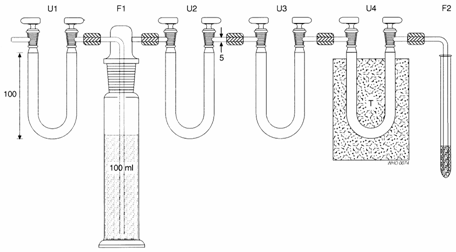
A. The apparatus (Fig. 6) consists of the following parts connected in series:
- a U-tube (U1) containing desiccant silica gel R impregnated with chromium trioxide R;
- a wash bottle (F1) containing 100 mL of potassium hydroxide (~400 g/l) TS;
- a U-tube (U2) containing pellets of potassium hydroxide R;
- a U-tube (U3) containing phosphorus pentoxide R dispersed on previously granulated, fused pumice;
- a U-tube (U4) containing 30 g of recrystallized iodine pentoxide R in granules, previously dried at 200 °C and kept at a temperature of 120°C (T) during the test. The iodine pentoxide is packed in the tube in 1-cm columns separated by 1-cm columns of glass wool to give an effective length of 5 cm;
- a reaction tube (F2) containing 2.0 mL of potassium iodide (160 g/l) TS and 0.15 mL of starch TS.
Flush the apparatus with 5.0 litres of argon R. If necessary, discharge the blue colour in tube F2 containing potassium iodide (160 g/l) TS by adding a sufficient volume of freshly prepared sodium thiosulfate (0.002 mol/l) VS. Continue flushing with argon R until not more than 0.045 mL of sodium thiosulfate (0.002 mol/l) VS is required after the passage of 5.0 litres of argon R. Pass 5.0 litres of the test gas from the container through the apparatus. Flush the last traces of liberated iodine into the reaction tube by passing 1.0 litre of argon R through the apparatus. Titrate the liberated iodine with sodium thiosulfate (0.002 mol/l) VS. Repeat the procedure using 5.0 litres of argon R.
|
Figure 6. |
Apparatus for the determination of carbon monoxide in medicinal gases |
|
Measurements in mm. |
Reproduced with the permission of the European Pharmacopoeia Commission, European Directorate for the Quality of Medicines, Council of Europe.
The difference between the volumes of sodium thiosulfate (0.002 mol/l) VS used in the titrations is not more than 0.25 mL (5μl/l).
B. Carry out the test as described under 1.14.1 Chromatography, Gas chromatography, using a stainless steel column (2m × 4mm) packed with a 0.5-nm molecular sieve (e.g. X13, obtainable from a commercial source). Maintain the column at 80 °C, and the injection port and the detector at room temperature. Use helium R as the carrier gas at a flow rate of 60 mL per minute, and a helium ionization detector.
Use the following gases: (1) the test gas; and (2) a mixture containing 5μl of carbon monoxide R in 1 litre of dinitrogen oxide R as the reference gas.
Inject a suitable volume of both gases (1) and (2). Adjust the volume, as well as the conditions specified above, to produce a peak response for carbon monoxide obtained with the reference gas (2) that gives a height of not less than 5% on the recorder.
Measure the areas of the peak responses obtained in the chromatograms from injections 1 and 2 and calculate the content of carbon monoxide in the test gas (1) by comparing with the peak response for carbon monoxide obtained from the reference gas (2); not more than 5μl/l.
C. Determine the content using a carbon monoxide detector tube. Pass the required volume of the test gas through the tube, the calibration of which is verified according to the manufacturer's instructions.
The gas supply is connected to a pressure regulator and needle valve. Connect the flexible tubing fitted with a Y-piece to the valve and adjust the flow of the test gas to purge the tubing to an appropriate flow. Fit the carbon monoxide detector tube to the metering pump according to the manufacturer's instructions. Connect the open end of the tube to the short leg of the tubing and pump a suitable volume of the test gas through the tube. Read the value corresponding to the length of the coloured layer or the intensity of the colour on the graduated scale; not more than 5μl/l.
Note: For the following tests - Nitrogen monoxide and nitrogen dioxide, Carbon dioxide Test A, Halogens and hydrogen sulfide, and Acidity and alkalinity - pass the gas to be tested through the appropriate reagent contained in a hermetically closed flat-bottomed glass cylinder, with dimensions such that 50ml of liquid reaches a height of 12-14 cm, that is fitted with (a) a delivery tube terminated by a capillary 1 mm in internal diameter and placed within 2mm of the bottom of the cylinder; and (b) an outlet tube.
Prepare the reference solutions in identical cylinders.
Nitrogen monoxide and nitrogen dioxide
• Either test A or test B may be applied.
• This test should be performed after release of the 5.0 litres of gas as described above under "Carbon monoxide, test A".
A. Pass the test gas through two of the cylinders connected in series as described above under "Carbon monoxide, test A". To obtain the liquid phase invert the gas cylinder; the liquid vaporizes on leaving the valve.
To 50 mL of water add 1.2 mL of sulfuric acid (~1760 g/l) TS and dilute with sufficient water to produce 100 mL. To 15 mL of this solution add 375mg of potassium permanganate R, mix, and transfer to the first cylinder (solution A).
Dissolve 1 g of sulfanilic acid R in a mixture of 180 mL of water and 10ml of glacial acetic acid R (solution 1). Separately dissolve 0.2g of N-(1- naphthyl)ethylenediamine hydrochloride R in a mixture of 4 mL of glacial acetic acid R and 5 mL of water, heat gently, and dilute to 200 mL with water (solution 2). Mix 1 volume of solution 2 with 9 volumes of solution 1 and transfer 20 mL of this mixture to the second cylinder (solution B).
Connect the outlet tube of the first cylinder to the delivery tube of the second cylinder containing solution B. Pass 2.5 litres of the test gas through the reagents at a rate of 15.0 litres per hour.
Prepare a reference solution by adding 0.25 mL of a solution containing 61.6μg/mL of sodium nitrite R in water to 20 mL of solution B as prepared above. Allow the test solution and reference solution to stand for 10 minutes.
Examine the gaseous and the liquid phases separately.
For both gaseous and liquid phases, any red colour produced from the solution of the test gas is not more intense than that from the reference solution (2μl/l of NO + NO2).
B. Determine the content using a nitrogen monoxide and nitrogen dioxide detector tube. Pass the required volume of the test gas through the tube, the calibration of which is verified according to the manufacturer's instructions.
The gas supply is connected to a pressure regulator and needle valve. Connect the flexible tubing fitted with a Y-piece to the valve and adjust the flow of the test gas to purge the tubing to an appropriate flow. Fit the nitrogen monoxide and nitrogen dioxide detector tube to the metering pump following the manufacturer's instructions. Connect the open end of the tube to the short leg of the tubing and pump a suitable volume of the test gas through the tube. Read the value corresponding to the length of the coloured layer or the intensity of the colour on the graduated scale; not more than 2μl/l.
Carbon dioxide
• Either test A, test B, or test C may be applied.
A. Pass 1.0 litre of the test gas through 50 mL of a clear solution of barium hydroxide (0.15 mol/l) VS. Similarly prepare a reference solution by adding 1.0 mL of a 1.1 mg/mL solution of sodium hydrogen carbonate R in carbondioxide- free water R to 50 mL of barium hydroxide (0.15 mol/l) VS.
Any turbidity in the solution after the passage of the the test gas is not more intense than that of the reference solution (300μl/l).
B. Carry out the test as described under 1.14.1 Chromatography, Gas chromatography, using a stainless steel column (3.5m × 2mm) packed with ethylvinyl-benzenedivinylbenzene copolymer. Maintain the column at 40 °C and the detector at 90 °C. Use helium R as the carrier gas at a flow rate of 15 mL per minute, and a thermal conductivity detector.
Use the following gases: (1) the test gas; and (2) a mixture containing 300μg of carbon dioxide R in 1 litre of dinitrogen oxide R as the reference gas.
Inject a suitable volume of both gases (1) and (2). Adjust the volume, as well as the conditions specified above, to obtain a peak response for carbon dioxide obtained with the reference gas (2) of a height of not less than 35% on the recorder.
Measure the areas of the peak responses obtained in the chromatograms from the injections of gases 1 and 2 and calculate the content of carbon dioxide in the test gas (1) by comparing with the peak response for carbon dioxide obtained from the reference gas (2); not more than 300μl of CO2 per litre.
C. Determine the content using a carbon dioxide detector tube. Pass the required volume of the test gas through the tube, the calibration of which is verified according to the manufacturer's instructions.
The gas supply is connected to a suitable pressure regulator and needle valve. Connect the flexible tubing fitted with a Y-piece to the valve and adjust the flow of the test gas to purge the tubing to an appropriate flow. Fit the carbon dioxide detector tube to the metering pump according to the manufacturer's instructions. Connect the open end of the tube to the short leg of the tubing and pump a suitable volume of the test gas through the tube. Read the value corresponding to the length of the coloured layer or the intensity of the colour on the graduated scale; not more than 300μl/l.
Halogens and hydrogen sulfide. Pass 20.0 litres of the test gas through a mixture of 1 mL of silver nitrate (40 g/L) TS and 49 mL of water at a flow rate not exceeding 15 litres per hour.
Prepare the reference solution as follows: to 1.0 mL of silver nitrate (40 g/L) TS add 40 mL of chloride standard (5μg/mL) TS and 0.15 mL of nitric acid (~130 g/L) TS, dilute to 50 mL with water, and allow to stand protected from light for 5 minutes. For the blank solution repeat the procedure passing the test gas through 50 mL of water.
Compare a 100 mm layer of the solution as described under 1.11.1 Colour of liquids.
The solution of the test gas does not darken when compared with the blank. Any opalescence is not more intense than that of the reference solution (10μg Cl per litre of dinitrogen oxide).
Water
• Either test A or test B may be applied.
A. The apparatus consists of either an electrolytic hygrometer as described below, an appropriate humidity detector tube, or a capacity hygrometer.
The measuring cell consists of a thin film of phosphoric anhydride placed between two coiled platinum wires which act as electrodes. The water vapour in Dinitrogen oxide is absorbed by the phosphoric anhydride to form phosphoric acid which acts as an electrical conductor.
Before introducing the test gas into the device, allow the gas to stabilize at room temperature and make sure that the temperature is constant throughout the apparatus. Apply a continuous voltage across the electrodes to produce electrolysis of the water and regeneration of phosphoric anhydride. Measure the resulting electric current, which is proportional to the water content in the test gas. (This is a self-calibrating system that obeys Faraday's law.)
Calculate the content of water; not more than 60μg/l.
B. Determine the content using a water vapour detector tube. Pass the required volume of the test gas through the tube, the calibration of which is verified according to the manufacturer's instructions.
The gas supply is connected to a suitable pressure regulator and needle valve. Connect the flexible tubing fitted with a Y-piece to the valve and adjust the flow of the test gas to purge the tubing to an appropriate flow. Fit the water vapour detector tube to the metering pump according to the manufacturer's instructions. Connect the open end of the tube to the short leg of the tubing and pump a suitable volume of the test gas through the tube. Read the value corresponding to the length of the coloured layer or the intensity of the colour on the graduated scale; not more than 60μl/l.
Acidity and alkalinity. Pass 2.0 litres of the test gas through a mixture of 0.10 mL of hydrochloric acid (0.01 mol/l) VS and 50 mL of carbon-dioxide-free water R.
For reference solution 1, use 50 mL of carbon-dioxide-free water R. For reference solution 2, use a mixture of 0.20 mL of hydrochloric acid (0.01 mol/l) VS and 50ml of carbon-dioxide-free water R.
To each solution add 0.1 mL of methyl red/ethanol TS; the intensity of the colour in the test gas solution is between that of reference solutions 1 and 2.
Assay. Determine as described under 1.14.1 Chromatography, Gas chromatography, using a stainless steel column (2m × 2mm) packed with silica gel for chromatography R (250-355μm). Maintain the column at 60 °C and the detector at 130°C. Use helium R as the carrier gas at a flow rate of 50 mL per minute, and a thermal conductivity detector.
Use the following gases: (1) the test gas; and (2) dinitrogen oxide R as the reference gas.
Inject a suitable volume of both gases (1) and (2). Adjust the volume, as well as the conditions specified above, to produce a peak response for dinitrogen oxide obtained with reference gas (2) that gives a height of not less than 35% on the recorder.
Measure the areas of the peak responses obtained in the chromatograms from the injections of gases (1) and (2), and calculate the percentage content of dinitrogen oxide.
 |  |