Monographs: Pharmaceutical substances: Phenoxymethylpenicillin potassium (Phenoxymethylpenicillinum kalicum)
Molecular formula. C16H17KN2O5S
Relative molecular mass. 388.5
Graphic formula.
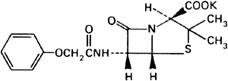
Chemical name. Potassium (2S,5R,6R)-3,3-dimethyl-7-oxo-6-(2-phenoxyacetamido)-4-thia-1-azabicyclo[3.2.0]heptane-2-carboxylate; potassium [2S-(2α,5α,6β)]-3,3-dimethyl-7-oxo-6-[(phenoxyacetyl)amino]-4-thia-1-azabicyclo-[3.2.0]heptane-2-carboxylate; CAS Reg. No. 132-98-9.
Description. A white or almost white, crystalline powder; odourless or with a faint characteristic odour.
Solubility. Soluble in about 1.5 parts of water; practically insoluble in ether R.
Category. Antibiotic.
Storage. Phenoxymethylpenicillin potassium should be kept in a tightly closed container; protected from light.
Additional information. Even in the absence of light, Phenoxymethylpenicillin potassium is gradually degraded on exposure to a humid atmosphere, the decomposition being faster at higher temperatures.
Requirements
Definition. Phenoxymethylpenicillin potassium contains not less than 95.0% and not more than 102.0% of C16H17KN2O5S, calculated with reference to the dried substance.
Identity tests
• Either tests A and D or tests B, C, and D may be applied.
A. Carry out the examination as described under 1.7 Spectrophotometry in the infrared region. The infrared absorption spectrum is concordant with the spectrum obtained from phenoxymethylpenicillin potassium RS or with the reference spectrum of phenoxymethylpenicillin potassium.
B. To 2 mg in a test-tube add 1 drop of water followed by 2 mL of sulfuric acid (~1760 g/l) TS and mix; the solution is colourless. Immerse the test-tube for 1 minute in a water-bath; the solution remains colourless.
C. Place 2 mg in a test-tube, add 1 drop of water and 2 mL of formaldehyde/sulfuric acid TS and mix; the solution is red. Immerse the test-tube for 1 minute in a water-bath; a red-brown colour is produced.
D. Ignite a small quantity, dissolve the residue in water and filter. To the filtrate, add 2 mL of sodium hydroxide (~80 g/l) TS; it yields the reaction described under 2.1 General identification tests as characteristic of potassium.
Specific optical rotation. Use a 10 mg/mL solution and calculate with reference to the dried substance;  = +215° to +235°.
Clarity of solution. A solution of 0.2 gin 10 mL of water is not more than slightly opalescent.
Loss on drying. Dry to constant weight at 105°C; it loses not more than 15 mg/g.
pH value. pH of a 5.0 mg/mL solution in carbon-dioxide-free water R, 5.0-7.5.
p -Hydroxyphenoxymethylpenicillin. Dissolve about 0.11 g, accurately weighed, in sufficient sodium hydroxide (0.1 mol/l) VS to produce 100 mL. Measure the absorbance of a 1-cm layer at the maximum at about 306 nm; not more than 0.36 (preferably use 2-cm cells for the measurement and calculate the absorbance of a 1-cm layer).
Ultraviolet absorbance range. Dilute 20 mL of the solution obtained in the test for p-hydroxyphenoxymethylpenicillin to 100 mL with sodium hydroxide (0.1 mol/l) VS. Measure the absorbance of a 1-cm layer at the maximum at about 274 nm; not less than 0.56 and not more than 0.62.
Assay. Dissolve about 50 mg, accurately weighed, in sufficient water to produce 1000 mL. Transfer two 2.0-mL aliquots of this solution into separate stoppered tubes. To one tube add 10.0 mL of imidazole/mercuric chloride TS, mix, stopper the tube and place it in a water-bath at 60°C for exactly 25 minutes. Cool the tube rapidly to 20°C (solution A). To the second tube add 10.0 mL of Water and mix (solution B).
Without delay measure the absorbance of a 1-cm layer at the maximum at about 325 nm against a solvent cell containing a mixture of 2.0 mL of water and 10.0 mL of imidazole/mercuric chloride TS for solution A and water for solution B.
From the difference between the absorbance of solution A and that of solution B, calculate the amount of C16H17KN2O5S in the substance being tested by comparison with phenoxymethylpenicillin potassium RS, similarly and concurrently examined. In an adequately calibrated spectrophotometer the absorbance of the reference solution should be 0.63 ± 0.03.
 |  |