Monographs: Pharmaceutical substances: Povidone (Povidonum)
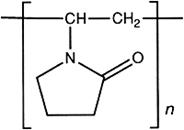
(C6H9NO)n
Chemical name. 1-Vinyl-2-pyrrolidinone polymer; 1-ethenyl-2-pyrrolidinone homopolymer; CAS Reg. No. 9003-39-8.
Other name. Povidone, polyvinylpyrrolidone.
Description. A white to creamy white powder; odourless or almost odourless.
Solubility. Soluble in water and ethanol (~750 g/l) TS; practically insoluble in ether R.
Category. Tablet binder; tablet coating; viscosity-increasing agent.
Storage. Povidone should be kept in a tightly closed container.
Labelling. The designation on the container of Povidone should state its viscosity.
Additional information. Povidone is hygroscopic. It is not necessarily suitable for use as a plasma extender.
Requirements
Definition. Povidone consists of linear polymers of 1-vinyl-2-pyrrolidinone groups, the degree of polymerization of which results in polymers of various molecular masses ranging from about 10 000 to 700 000.
Povidone contains not less than 11.5% and not more than the equivalent of 12.8% of nitrogen N, calculated with reference to the anhydrous substance.
Identity tests
A. Dissolve 0.5 g in 5 mL of water and add 10 mL of hydrochloric acid (1 mol/l) VS and 2 mL of potassium dichromate (100 g/l) TS; an orange-yellow precipitate is formed.
B. Dissolve 0.1 g in 1 mL of water and add 0.2 mL of 4-dimethylaminobenzaldehyde TS6 and 0.1 mL of sulfuric acid (~1760 g/l) TS; a pink colour is produced.
Heavy metals. Use 1.0 g for the preparation of the test solution as described under 2.2.3 Limit test for heavy metals, Procedure 1; determine the heavy metals content according to Method A; not more than 10 μg/g.
Sulfated ash. Not more than 1.0 mg/g.
Water. Determine as described under 2.8 Determination of water by the Karl Fischer method, Method A, using 0.5 g; the water content is not more than 50 mg/g.
Aldehydes. To 10 g add 180 mL of sulfuric acid (~440 g/l) TS and boil under a reflux condenser for 45 minutes. Cool, reassemble the apparatus, distil, and collect 100 mL of distillate in a flask that is placed in an ice-bath and contains 20 mL of hydroxylamine hydrochloride (70 g/l) TS previously adjusted to pH 3.1. Titrate the distillate with sodium hydroxide (0.1 mol/l) VS to pH 3.1. Repeat the procedure without the Povidone being examined and make any necessary corrections. Each mL of sodium hydroxide (0.1 mol/l) VS is equivalent to 4.405 mg of aldehyde, calculated as acetaldehyde. Not more than 4.6 mL of sodium hydroxide (0.1 mol/l) VS is required (2.0 mg/g).
Vinylpyrrolidinone. Dissolve 10 g in 80 mL of water, add 1 g of sodium acetate R and titrate with iodine (0.05 mol/l) VS until a permanent colour is obtained. Add an excess of 3.0 mL of iodine (0.05 mol/l) VS, allow to stand for 10 minutes, and titrate the excess iodine with sodium thiosulfate (0.1 mol/l) VS, adding starch TS towards the end of the titration. Repeat the procedure without the Povidone being examined and make any necessary corrections. Not more than 3.6 mL of iodine (0.05 mol/l) VS is required (2.0 mg/g).
Assay. Carry out Method A as described under 2.10 Determination of nitrogen, using about 0.3 g, accurately weighed, and 11 mL of nitrogen-free sulfuric acid (~1760 g/l) TS. Carefully add 1 mL of hydrogen peroxide (~330 g/l) TS down the wall of the flask, and heat. Repeat this addition three to six times, and continue to heat until a slightly green and clear solution is produced. Proceed with the distillation as described. Repeat the procedure without the Povidone being examined and make any necessary corrections.
Each mL of sulfuric acid (0.05 mol/l) VS is equivalent to 1.401 mg of N.
 |  |