Monographs: Pharmaceutical substances: Sodium amidotrizoate (Natrii amidotrizoas)
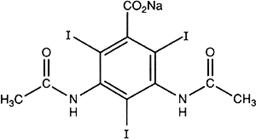
C11H8I3N2NaO4
Relative molecular mass. 635.9
Chemical name. Monosodium 3,5-diacetamido-2,4,6-triiodobenzoate; monosodium 3,5-bis(acetylamino)-2,4,6-triiodobenzoate; CAS Reg. No. 737-31-5.
Other names. Sodium diatrizoate; diatrizoate sodium.
Description. A white powder; odourless or almost odourless.
Solubility. Freely soluble in water; slightly soluble in ethanol (~750 g/l) TS; practically insoluble in acetone R and ether R.
Category. Radiocontrast medium.
Storage. Sodium amidotrizoate should be kept in a well-closed container, protected from light.
Requirements
Sodium amidotrizoate contains not less than 98.0% and not more than the equivalent of 102.0% of C11H8I3N2NaO4, calculated with reference to the anhydrous substance.
Identity tests
• Either tests A and E or tests B, C, D, and E may be applied.
A. Carry out the examination as described under 1.7 Spectrophotometry in the infrared region. The infrared absorption spectrum is concordant with the spectrum obtained from sodium amidotrizoate RS or with the reference spectrum of sodium amidotrizoate.
B. Carry out the test as described under 1.14.1 Chromatography, Thin-layer chromatography, using silica gel R4 as the coating substance and 20 volumes of chloroform R, 10 volumes of methanol R, and 2 volumes of ammonia (~260 g/l) TS as the mobile phase. Apply separately to the plate 10 μl of each of two solutions in a mixture of 80 mg of sodium hydroxide R in 100 mL of methanol R containing (A) 1 mg of Sodium amidotrizoate per mL and (B) 1 mg of sodium amidotrizoate RS per mL. After removing the plate from the chromatographic chamber, allow it to dry in air, and examine the chromatogram in ultraviolet light (254 nm).
The principal spot obtained with solution A corresponds in position, appearance, and intensity with that obtained with solution B.
C. Place 20 mg into a flask, add 5 mL of sodium hydroxide (~80 g/l) TS, and boil gently under a reflux condenser for 10 minutes. Cool, add 5 mL of hydrochloric acid (~70 g/l) TS, and cool in ice for 5 minutes. Add 4 mL of sodium nitrite (10 g/l) TS, cool in ice for 5 minutes, add 0.3 g of sulfamic acid R, swirl gently until effervescence ceases, and add 2 mL of N-(1-naphthyl)ethylenediamine hydrochloride (5 g/l) TS; an orange-red colour is produced.
D. Heat 0.1 g in a suitable crucible; violet vapours are evolved.
E. When tested for sodium as described under 2.1 General identification tests, yields the characteristic reactions. If reaction B is to be used, prepare a 20 mg/mL solution.
Heavy metals. Use 1.0 g for the preparation of the test solution as described under 2.2.3 Limit test for heavy metals, Procedure 1; determine the heavy metals content according to Method A; not more than 20 μg/g.
Iodides. Dissolve 0.8 g in 10 mL of water, add drop by drop nitric acid (~130 g/l) TS until complete precipitation is obtained, then add an excess of 3 mL. Filter, and wash the precipitate with 5 mL of water; to the filtrate add 1 mL of hydrogen peroxide (~330 g/l) TS and 1 mL of chloroform R, and shake. To serve as a reference solution, treat similarly 2 mL of iodide standard (20 μg I/mL) TS with 3 mL of nitric acid (~130 g/l) TS and sufficient water to equal the volume of the solution to be tested. Any red-violet colour in the chloroform layer is not darker than that obtained from the reference solution.
Clarity and colour of solution. A solution of 0.2 g in 10 mL of water is clear and colourless.
Water. Determine as described under 2.8 Determination of water by the Karl Fischer method, Method A, using 0.4 g; the water content is not more than 100 mg/g.
pH value. pH of a 0.50 g/mL solution, 7.5-9.5.
Primary aromatic amines. Place about 1 g, accurately weighed, in a 50-mL volumetric flask, and add 5 mL of water, 10 mL of sodium hydroxide (0.1 mol/l) VS, and 25 mL of dimethyl sulfoxide R. Stopper the flask, mix the contents by gentle swirling, and allow to stand in an ice-bath, protected from light, for 5 minutes. Keeping the flask in the ice-bath add slowly 2 mL of hydrochloric acid (~250 g/l) TS, mix, and allow to stand for 5 minutes. Add 1.5 mL of sodium nitrite (35 g/l) TS, mix, and allow to stand for 5 minutes. Add 2 mL of sulfamic acid (50 g/l) TS, mix, and again allow to stand for 5 minutes. Add 2 mL of N-(1-naphthyl)ethylenediamine hydrochloride/1-propanol TS and mix. Remove the flask from the ice-bath and allow to stand in water at 22-25 °C for 10 minutes with occasional gentle shaking. Dilute to 50 mL with dimethyl sulfoxide R and mix.
Within 5 minutes after the addition of the last reagent measure the absorbance at about 470 nm, against a solvent cell containing the reagents prepared in a similar manner. The absorbance does not exceed 0.40.
Assay. To about 0.3 g, accurately weighed, add 30 mL of sodium hydroxide (50 g/l) TS and 0.5 g of zinc R powder. Boil under a reflux condenser for 1 hour. Cool the flask to room temperature, rinse the condenser with 20 mL of water, and filter. Thoroughly rinse the flask and add the rinse liquid to the filter. To the filtrate add 5 mL of glacial acetic acid R and 1 mL of tetrabromophenolphthalein ethyl ester TS and titrate with silver nitrate (0.05 mol/l) VS until the yellow precipitate formed just turns green.
Each mL of silver nitrate (0.05 mol/l) VS is equivalent to 10.60 mg of C11H8I3N2NaO4.
 |  |