Monographs: Pharmaceutical substances: Sodium citrate (Natrii citras)
Sodium citrate, anhydrous
Sodium citrate, dihydrate
Molecular formula. C6H5Na3O7 (anhydrous); C6H5Na3O7,2H2O (dihydrate).
Relative molecular mass. 258.1 (anhydrous); 294.1 (dihydrate).
Graphic formula.
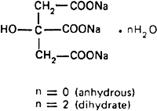
Chemical name. Trisodium citrate; trisodium 2-hydroxy-1,2,3-propanetricarboxylate; CAS Reg. No. 68-04-2 (anhydrous).
Trisodium citrate dihydrate; trisodium 2-hydroxy-1,2,3-propanetricarboxylate dihydrate; CAS Reg. No. 6132-04-3 (dihydrate).
Description. Colourless crystals or a white, crystalline powder; odourless.
Solubility. Freely soluble in water and very soluble in boiling water; practically insoluble in ethanol (~750 g/l) TS and ether R.
Category. Systemic alkalinizing agent; component of oral rehydration salt mixtures.
Storage. Sodium citrate should be kept in a tightly closed container.
Labelling. The designation on the container of Sodium citrate should state whether the substance is the dihydrate or is in the anhydrous form.
Additional information. Sodium citrate is slightly deliquescent in moist air.
Requirements
Definition. Sodium citrate contains not less than 99.0% and not more than 101.0% of C6H5Na3O7, calculated with reference to the anhydrous substance.
Identity tests
A. When tested for sodium as described under 2.1 General identification tests, yields the characteristic reactions. If reaction B is to be used, prepare a 20 mg/mL solution.
B. A 20 mg/mL solution yields reaction B described under 2.1 General identification tests as characteristic of citrates.
Heavy metals. Use 1.0 g for the preparation of the test solution as described under 2.2.3 Limit test for heavy metals, Procedure 1; determine the heavy metals content according to Method A; not more than 10 μg/g.
Oxalates. Dissolve 0.5 g in 4 mL of water, add 3 mL of hydrochloric acid (~420 g/l) TS and 1 g of granulated zinc R, and heat on a water-bath for 1 minute. Allow to stand for 2 minutes, decant the liquid into a test-tube containing 0.25 mL of phenylhydrazine hydrochloride (10 g/l) TS, and heat to boiling. Cool rapidly, transfer to a graduated cylinder, and add an equal volume of hydrochloric acid (~420 g/l) TS, followed by 0.25 mL of potassium ferricyanide (50 g/l) TS. Shake and allow to stand for 30 minutes; any pink colour produced is not more intense than that of a similarly treated solution containing 4 mL of oxalic acid (0.05 g/l) TS.
Clarity and colour of solution. A solution of 1.0 g in 10 mL of carbon-dioxide-free water R is clear and colourless.
Water. Determine as described under 2.8 Determination of water by the Karl Fischer method, Method A. For the anhydrous form use about 1 g of the substance; the water content is not more than 10 mg/g. For the dihydrate use about 0.3 g of the substance; the water content is not less than 0.10 g/g and not more than 0.13 g/g.
Acidity or alkalinity. Dissolve 1 g in 10 mL of carbon-dioxide-free water R and add 0.1 mL of phenolphthalein/ethanol TS; not more than 0.2 mL of hydrochloric acid (0.1 mol/l) VS or 0.2 mL of sodium hydroxide (0.1 mol/l) VS is required to change the colour of the solution.
Assay. Dissolve about 0.15 g, accurately weighed, in 20 mL of glacial acetic acid R1, heat to about 50°C, allow to cool to room temperature, add 0.25 mL of 1-naphtholbenzein/acetic acid TS, and titrate with perchloric acid (0.1 mol/l) VS until a green colour is obtained as described under 2.6 Non-aqueous titration, Method A. Each mL of perchloric acid (0.1 mol/l) VS is equivalent to 8.603 mg of C6H5Na3O7.
 |  |