Monographs: Pharmaceutical substances: Sodium nitroprusside (Natrii nitroprussidum)
Molecular formula. Na2[Fe(CN)5NO],2H2O
Relative molecular mass. 298.0
Graphic formula.
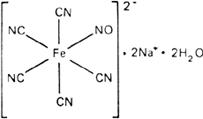
Chemical name. Disodium pentacyanonitrosylferrate(2-) dihydrate; disodium (OC-6-22)-pentakis(cyano-C)nitrosylferrate(2-) dihydrate; CAS Reg. No. 13755-38-9 (dihydrate).
Other names. Sodium nitroferricyanide; sodium nitroprussiate.
Description. Reddish brown crystals or powder; odourless or almost odourless.
Solubility. Freely soluble in water; slightly soluble in ethanol (~750 g/l)TS.
Category. Antihypertensive drug.
Storage. Sodium nitroprusside should be kept in a tightly closed container, protected from light.
Requirements
Definition. Sodium nitroprusside contains not less than 99.0% and not more than 100.5% of Na2[Fe(CN)5NO], calculated with reference to the anhydrous substance.
Identity tests
A. The absorption spectrum of a 4.0 mg/mL solution, when observed between 350 nm and 600 nm, exhibits a maximum at about 395 nm; the absorbance of a 1-cm layer at this wavelength is about 1.10.
B. When tested for sodium as described under 2.1 General identification tests yields the characteristic reactions. If reaction B is to be used, prepare a 0.10 g/mL solution acidified with acetic acid (~300 g/l) TS.
C. Dissolve 5 mg in 2.0 mL of water, add 0.1 mL of acetone R and 0.5 mL of sodium hydroxide (~80 g/l) TS; an orange colour is produced. Add about 2 mL of acetic acid (~300 g/l) TS; the colour changes to purple.
Chlorides. Dissolve 1.20 g in a mixture of 2 mL of nitric acid (~130 g/l) TS and 30 mL of water, and proceed as described under 2.2.1 Limit test for chlorides; the chloride content is not more than 0.2 mg/g.
Sulfates. Dissolve 5.0 g in 40 mL of water and proceed as described under 2.2.2 Limit test for sulfates; the sulfate content is not more than 0.1 mg/g.
Ferricyanide. Dissolve 0.50 g in 20 mL of ammonium acetate buffer, pH 4.62, TS, and divide the solution into two equal portions, A and B. To portion B add 1 mL of ferricyanide standard (50 μg/mL) TS, then add to both portions 5 mL of ferrous ammonium sulfate (1 g/l) TS and dilute to 50 mL with water. Prepare a blank solution by dissolving 0.25 g of the substance to be examined in 10 mL of ammonium acetate buffer, pH 4.62, TS, and diluting to 50 mL with water. Allow to stand for 1 hour and measure the absorbance of the solutions at the maximum at about 720 nm. The absorbance of portion A when measured against the blank is not greater than the absorbance of portion B when measured against portion A (0.2 mg/g).
Ferrocyanide. Dissolve 2.0 g in 40 mL of water and divide the solution into two equal portions, A and B. To portion B add 2 mL of ferrocyanide standard (100 μg/mL) TS, then add to both portions 0.2 mL of ferric chloride (50 g/l) TS and dilute to 50 mL with water. Allow to stand for 5 minutes. Prepare a blank solution by dissolving 1.0 g of the substance to be examined in sufficient water to produce 50 mL. Measure the absorbance of the solutions at the maximum at about 695 nm. The absorbance of portion A when measured against the blank is not greater than the absorbance of portion B when measured against portion A (0.2 mg/g).
Insoluble matter. Dissolve 10.0 g in 50 mL of water, heat the solution on a water-bath for 30 minutes, filter, wash the insoluble matter with water, and dry to constant weight at 105°C; the content of insoluble matter is not more than 0.1 mg/g.
Water. Determine as described under 2.8 Determination of water by the Karl Fischer method, Method A, using about 1 g of the substance; the water content is not less than 90 mg/g and not more than 150 mg/g.
Assay. Dissolve about 0.35 g, accurately weighed, in 100 mL of water. Add 0.1 mL of sulfuric acid (~100 g/l) TS and 20 mL of ethanol (~750 g/l) TS. Titrate with silver nitrate (0.1 mol/l) VS, determining the end-point potentiometrically using a silver/silver chloride electrode system. Each mL of silver nitrate (0.1 mol/l) VS is equivalent to 13.10 mg of Na2[Fe(CN)5NO].
 |  |