Monographs: Pharmaceutical substances: Sodium valproate (Natrii valproas)
Molecular formula. C8H15NaO2
Relative molecular mass. 166.2
Graphic formula.
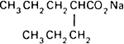
Chemical name. Sodium 2-propylvalerate; sodium 2-propylpentanoate; CAS Reg. No. 1069-66-5.
Description. A white or almost white, crystalline powder; odourless or almost odourless.
Solubility. Freely soluble in water and ethanol (~750 g/l) TS.
Category. Antiepileptic drug.
Storage. Sodium valproate should be kept in a well-closed container.
Additional information. Sodium valproate is deliquescent.
Requirements
Definition. Sodium valproate contains not less than 98.0% and not more than 101.0% of C8H15NaO2, calculated with reference to the dried substance.
Identity tests
A. Dissolve 0.5 g in 5 mL of water, add 5 mL of chloroform R and 1 mL of hydrochloric acid (~70 g/l) TS, shake vigorously for 1 minute, allow to separate, dry the lower layer with anhydrous sodium sulfate R, filter, and evaporate to dryness. Carry out the examination of a thin film of the residue as described under 1.7 Spectrophotometry in the infrared region. The infrared absorption spectrum is concordant with the spectrum obtained from valproic acid RS or with the reference spectrum of valproic acid.
B. Dissolve 0.5 g in 5 mL of water and add 1 mL of cobalt(II) nitrate (100 g/l) TS; a purple precipitate is produced, which is soluble in carbon tetrachloride R.
C. A 20 mg/mL solution yields reaction B, described under 2.1 General identification tests as characteristic of sodium.
Heavy metals. Use 1.0 g for the preparation of the test solution as described under 2.2.3 Limit test for heavy metals, Procedure 3; determine the heavy metals content according to Method A; not more than 20 μg/g.
Arsenic. Use a solution of 5.0 g in 35 mL of water and proceed as described under 2.2.5 Limit test for arsenic; the arsenic content is not more than 2 μg/g.
Chlorides. Dissolve 1.20 g in a mixture of 2 mL of nitric acid (~130 g/l) TS and 20 mL of water, and proceed as described under 2.2.1 Limit test for chlorides; the chloride content is not more than 0.2 mg/g.
Iron. Using 0.2 g prepare a solution in 40 mL of water and proceed as described under 2.2.4 Limit test for iron; not more than 50 μg/g.
Sulfates. Dissolve 2.5 g in 20 mL of water and proceed as described under 2.2.2 Limit test for sulfates; the sulfate content is not more than 0.2 mg/g.
Clarity and colour of solution. The opalescence of a solution of 2.0 g in 10 mL of carbon-dioxide-free water R is not more intense than that of opalescence standard TS2 and the solution is colourless.
Loss on drying. Dry to constant weight at 105°C; it loses not more than 20 mg/g.
Acidity or alkalinity. Dissolve 2.0 g in 20 mL of carbon-dioxide-free water R and add 0.1 mL of phenolphthalein/ethanol TS; not more than 1.5 mL of sodium hydroxide (0.1 mol/l) VS or 1.5 mL of hydrochloric acid (0.1 mol/l) VS is required to obtain the midpoint of the indicator (pink).
Related substances. Carry out the test as described under 1.14.1 Chromatography, Gas chromatography using 3 solutions:
Solution 1. 0.20 mg of octanoic acid R (internal standard) per mL of dichloromethane R.
Solution 2. Dissolve 0.50 g of the substance being examined in 10 mL of water, acidify with sulfuric acid (~190 g/l) TS, and shake with 3 quantities, each of 20 mL, of dichloromethane R. Wash the combined dichloromethane extracts with 10 mL of water, shake with anhydrous sodium sulfate R, filter and evaporate the filtrate at a temperature not exceeding 30 °C to a volume of about 10 mL, using a rotary evaporator.
Solution 3. Dissolve 0.50 g of the substance being examined in 10 mL of a mixture of 2.0 mg of octanoic acid R in 10 mL of sodium hydroxide (0.1 mol/l) VS, acidify with sulfuric acid (~190 g/l) TS, and shake with 3 quantities, each of 20 mL, of dichloromethane R. Wash the combined dichloromethane extracts with 10 mL of water, shake with anhydrous sodium sulfate R, filter and evaporate the filtrate at a temperature not exceeding 30 °C to a volume of about 10 mL, using a rotary evaporator.
For the procedure use a glass column, 1.5 m long and 0.4 cm in internal diameter, packed with an adequate quantity of an adsorbent composed of 15 g of a phase consisting of an ester of macrogol 20M and terephthalic acid, together with 1 g of phosphoric acid (~1440 g/l) TS supported on 84 g of acid-washed, silanized diatomaceous support R (150-180 μm). Maintain the column at 170°C, use nitrogen R as the carrier gas and a flame ionization detector. In the chromatogram obtained with solution 3, the total area of all the peaks, excluding the main peak and those due to the solvent and the internal standard, is not greater than the area of the peak due to the internal standard.
Assay. Dissolve about 0.25 g, accurately weighed, in 30 mL of glacial acetic acid R1, add 0.15 mL of 1-naphtholbenzein/acetic acid TS as indicator and titrate with perchloric acid (0.1 mol/l) VS, as described under 2.6 Non-aqueous titration, Method A. Each mL of perchloric acid (0.1 mol/l) VS is equivalent to 16.62 mg of C8H15NaO2.
 |  |