Monographs: Pharmaceutical substances: Spironolactone (Spironolactonum)
Molecular formula. C24H32O4S
Relative molecular mass. 416.6
Graphic formula.
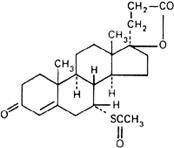
Chemical name. 17-Hydroxy-7α-mercapto-3-oxo-17α-pregn-4-ene-21-carboxylic acid γ-lactone acetate; 7α-(acetylthio)-17-hydroxy-3-oxo-17α-pregn-4-ene-21-carboxylic acid γ-lactone; CAS Reg. No. 52-01-7.
Description. A light yellowish white to light yellowish brown powder; odourless or with a faint characteristic odour.
Solubility. Practically insoluble in water; soluble in ethanol (~750 g/l) TS.
Category. Diuretic.
Storage. Spironolactone should be kept in a well-closed container, protected from light.
Additional information. Spironolactone may show preliminary melting at about 135°C, followed by resolidification.
Requirements
Definition. Spironolactone contains not less than 97.0% and not more than 101.5% of C24H32O4S, calculated with reference to the dried substance.
Identity tests
• Either test A alone or tests B, C and D may be applied.
A. Carry out the examination as described under 1.7 Spectrophotometry in the infrared region. The infrared absorption spectrum is concordant with the spectrum obtained from Spironolactone RS or with the reference spectrum of Spironolactone.
B. The absorption spectrum of a 10 μg/mL solution in methanol R, when observed between 230 nm and 350 nm, exhibits a maximum at about 238 nm; the absorbance of a 1-cm layer at this wavelength is about 0.47.
C. Shake 10 mg with 2 mL of sulfuric acid (~700 g/l) TS; an orange solution with an intense yellowish green fluorescence is produced. Heat the solution gently; the colour changes to deep red and hydrogen sulfide, which blackens lead acetate paper R, is evolved. Pour the solution into water; a greenish yellow, opalescent solution is produced.
D. Melting temperature, about 204°C with decomposition.
Specific optical rotation. Use a 10 mg/mL solution in chloroform R:  = -33.0° to -37.0°.
Chromium. Place 0.20 g with 1 g of potassium carbonate R and 0.3 g of potassium nitrate R into a platinum crucible; mix, heat gently until fused, and ignite at 600-650°C until the carbon is removed. Cool, dissolve the residue as completely as possible in 10 mL of water using gentle heat, filter, and dilute with sufficient water to produce 20 mL. To 10 mL add 0.5 g of urea R and acidify with sulfuric acid (~190 g/l) TS, dilute to 20 mL with water, and add 0.5 mL of diphenylcarbazide TS. The colour produced is not deeper than that of a solution obtained by adding 1 mL of sulfuric acid (~190 g/l) TS to 0.50 mL of a freshly prepared solution containing 2.83 mg of potassium dichromate R in 100 mL of water, then diluting to 20 mL with water and adding 0.5 mL of diphenylcarbazide TS.
Sulfated ash. Not more than 1.0 mg/g.
Loss on drying. Dry to constant weight at 105°C; it loses not more than 5.0 mg/g.
Related substances. Carry out the test as described under 1.14.1 Chromatography, Thin-layer chromatography, using silica gel R5 as the coating substance (a precoated plate from a commercial source is suitable) and butyl acetate R as the mobile phase. Apply separately to the plate 5 μl of each of 2 solutions in chloroform R containing (A) 20 mg of the test substance per mL and (B) 0.20 mg of the test substance per mL. After removing the plate from the chromatographic chamber, allow it to dry at room temperature and develop the plate a second time allowing the solvent to ascend 15 cm above the line of application. Remove the plate, allow the solvent to evaporate at room temperature, spray it with sulfuric acid/methanol TS, and heat at 105°C for 10 minutes. Examine the chromatogram in daylight. Any spot obtained with solution A, other than the principal spot, is not more intense than that obtained with solution B.
Mercapto compounds. Shake 2.0 g with 20 mL of water, filter, and titrate 10 mL of the filtrate with iodine (0.005 mol/l) VS, using starch TS as indicator. Repeat the operation without the test substance and make any necessary corrections. Not more than 0.1 mL of iodine (0.005 mol/l) VS is required.
Assay. Dissolve about 10 mg, accurately weighed, in sufficient methanol R to produce 100 mL and dilute 10 mL of this solution to 100 mL with methanol R. Measure the absorbance of this solution in a 1-cm layer at the maximum at about 238 nm, and calculate the content of C24H32O4S, using the absorptivity value of 47 ( = 470).
 |  |