Monographs: Pharmaceutical substances: Sulfasalazine (Sulfasalazinum)
Molecular formula. C18H14N4O5S
Relative molecular mass. 398.4
Graphic formula.
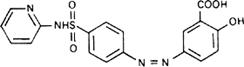
Chemical name. 5-[[p-(2-Pyridylsulfamoyl)phenyl]azo]salicylic acid; 2-hydroxy-5-[[4-[(2-pyridinylamino)sulfonyl]phenyl]azo]benzoic acid; CAS Reg. No. 599-79-1.
Other name. Salazosulfapyridine.
Description. A bright yellow to brownish yellow powder; odourless.
Solubility. Practically insoluble in water and ether R; very slightly soluble in ethanol (~750 g/l) TS; soluble in alkali hydroxides.
Category. Antibacterial drug.
Storage. Sulfasalazine should be kept in a tightly closed container, protected from light.
Additional information. Sulfasalazine melts at about 255°C with decomposition.
Requirements
Definition. Sulfasalazine contains not less than 93.0% and not more than 103.0% of C18H14N4O5S, calculated with reference to the dried substance.
Identity tests
• Either test A or tests B and C may be applied.
A. Carry out the examination as described under 1.7 Spectrophotometry in the infrared region. The infrared absorption spectrum is concordant with the spectrum obtained from sulfasalazine RS or with the reference spectrum of sulfasalazine.
B. The absorption spectrum of the solution as prepared in the assay below, when observed between 230 nm and 600 nm, exhibits maxima and minima at the same wavelengths as does the absorption spectrum of a solution of sulfasalazine RS prepared in a similar manner.
C. Dissolve 0.10 g in a mixture of 1.0 mL of ethanol (~750 g/l) TS and 4 mL of hydrochloric acid (~70 g/l) TS, then add 0.20 g of zinc R powder. Heat on a water-bath for 5 minutes and filter. To 1.0 mL of the nitrate add 0.1 mL of ferric chloride (25 g/l) TS; a red colour is produced. To 1.0 mL of the filtrate add 1.0 mL of sodium nitrite (10 g/l) TS and allow to stand for 1 minute. Then add 2.0 mL of sodium hydroxide (~80 g/l) TS and 0.1 mL of 2-naphthol TS1; a strong red colour is produced.
Heavy metals. Use 1.0 g for the preparation of the test solution as described under 2.2.3 Limit test for heavy metals, Procedure 3; determine the heavy metals content according to Method A; not more than 20 μg/g.
Chlorides. Digest 2.0 g with 100 mL of water at 70°C for 5 minutes. Cool immediately to room temperature and filter. To 25 mL of the filtrate (keep the remaining filtrate for the limit test for sulfates) add 1 mL of nitric acid (~1000 g/l) TS and allow to stand for 5 minutes. Filter through a fine-texture filter-paper and proceed with the filtrate as described under 2.2.1 Limit test for chlorides; the chloride content is not more than 0.14 mg/g.
Sulfates. To 25 mL of the filtrate retained from the limit test for chlorides add 1.5 mL of hydrochloric acid (2 mol/l) VS and allow to stand for 5 minutes. Filter through a fine-texture filter-paper and proceed with the filtrate as described under 2.2.2 Limit test for sulfates; the sulfate content is not more than 0.4 mg/g.
Sulfated ash. Not more than 5.0 mg/g.
Loss on drying. Dry to constant weight at 105°C; it loses not more than 10 mg/g.
Assay. Carry out the test as described under 1.14.1 Chromatography, Thin-layer chromatography using silica gel R2 as the coating substance and a mixture of 4 volumes of chloroform R, 1 volume of 1-butanol R, 1 volume of acetone R, and 1 volume of formic acid (~1080 g/l) TS as the mobile phase, allowing the chamber to equilibrate for 18 hours. Apply separately to the plate 10 μl of each of 2 solutions in dimethylformamide R containing (A) 12 mg of the test substance per mL, (B) 12 mg of sulfasalazine RS per mL, and (C) 10 μl of dimethylformamide R to serve as a blank. Dry the spotted plate thoroughly at room temperature to remove traces of dimethylformamide and develop the plate over a distance of 15 cm. After removing the plate from the chromatographic chamber, mark the solvent front and allow the solvent to evaporate. Locate the spots by examination of the chromatogram in ultraviolet light (254 nm) and mark the sulfasalazine spots at an Rf value of about 0.6, excluding an adjacent impurity band. Remove quantitatively and separately the silica gel mixture containing each of the 3 spots from solutions A, B and C, transferring them to separate glass-stoppered centrifuge tubes. (NOTE: The dimethylformamide R employed in the next step should be obtained from a recently opened bottle and should contain less than 10 mg of water per g. Dimethylformamide dried over alkali pellets is not acceptable.) Add 10.0 mL of dimethylformamide R to each tube, insert the stopper, shake for 10 minutes, and centrifuge until clear. Measure the absorbance of the solutions in a 1-cm layer at the maximum at about 406 nm against a solvent cell containing the blank obtained from solution C. Calculate the amount of C18H14N4O5S in the substance being tested (solution A) by comparison with sulfasalazine RS (solution B).
 |  |