Monographs: Pharmaceutical substances: Ceftriaxone sodium (Ceftriaxonum natricum)
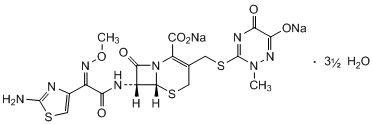
C18H16N8Na2O7S3,3½H2O
Relative molecular mass. 661.60
Chemical name. Disodium (6R,7R)-7-[(2Z)-2-(2-amino-1,3-thiazol-4-yl)-2-(methoxyimino)acetamido]-3-{[(2-methyl-6-oxido-5-oxo-2,5-dihydro-1,2,4-triazin-3-yl)sulfanyl]methyl}-8-oxo-5-thia-1-azabicyclo[4.2.0]oct-2-ene-2-carboxylate hemiheptahydrate. CAS Reg. No. 104376-79-6.
Description. Almost white or yellowish, slightly hygroscopic, crystalline powder.
Solubility. Freely soluble in water, sparingly soluble in methanol, very slightly soluble in anhydrous ethanol.
Labelling. The label states, where applicable:
- that the substance is free of bacterial endotoxins;
- that the substance is sterile.
Category. Antibacterial.
Storage. Ceftriaxone sodium should be kept in an air-tight container protected from light. If the substance is sterile, store in a sterile and air-tight container protected from light.
Manufacture. Where necessary, the production method is validated to demonstrate that the substance, if tested, would comply with limits of not more than 20 ppm for N,N-dimethylaniline and 0.8% for 2-ethylhexanoic acid.
Additional information. Ceftriaxone sodium is a semisynthetic product derived from a fermentation product.
Requirements
Definition. Ceftriaxone sodium contains not less than 96.0% and not more than 102.0% of C18H16N8Na2O7S3, calculated with reference to the anhydrous substance.
Identity tests
- Either tests A and D or tests B, C and D may be applied.
A. Carry out the examination as described under 1.7 Spectrophotometry in the infrared region. The infrared absorption spectrum is concordant with the spectrum obtained from ceftriaxone sodium RS or with the reference spectrum of ceftriaxone sodium.
B. Carry out the test as described under 1.14.1 Chromatography, High-performance liquid chromatography using the conditions given under “Assay”. The retention time of the principal peak in the chromatogram obtained with solution (1) corresponds to the retention time of the peak corresponding to ceftriaxone in the chromatogram obtained with solution (2).
C. Carry out the test as described under 1.14.1 Chromatography, Thin-layer chromatography using silica gel R6 as the coating substance and a mixture of 9 volumes of methanol R and 1 volume of water R. Apply separately to the plate 1 µL of each of 2 solutions in water R containing (A) 4 mg of the test substance per mL and (B) 4 mg of ceftriaxone sodium RS per mL. After removing the plate from the chromatographic chamber allow it to dry in air and examine the chromatogram in ultraviolet light (254 nm). The principal spot obtained with solution (A) corresponds in position, appearance and intensity with that obtained with solution (B).
D. When tested for sodium as described under 2.1 General identification tests, yields the characteristic reaction.
Specific optical rotation (1.4). Dissolve 0.250 g in water R and dilute to 25.0 mL with the same solvent. Calculate with reference to the anhydrous substance;  = -155° to -170°.
Clarity and colour of solution. Dissolve 2.40 g in carbon-dioxide-free water R and dilute to 20.0 mL with the same solvent (solution (A)). Dilute 2 mL of solution (A) to 20 mL carbon-dioxide-free water R. The solution is clear and not more intensely coloured than reference solution Y5 or BY5 when compared as described under 1.11.2 Degree of coloration of liquids. (Keep the remaining solution (A) for the “pH value”.)
pH value (1.13). pH of the solution prepared for the “Clarity and colour of solution” (solution (A)), 6.0 to 8.0.
Water. Determine as described under 2.8 Determination of water by the Karl Fischer method, method A, using 0.100 g of the test substance. The water content is not less than 80 mg per g and not more than 110 mg per g.
Bacterial endotoxins. If intended for use in the manufacture of a parenteral dosage form without a further appropriate procedure for the removal of bacterial endotoxins, carry out the test as described under 3.4 Test for bacterial endotoxins; contains not more than 0.08 IU of endotoxin per mg of ceftriaxone sodium.
Related substances
Carry out the test as described under 1.14.1 Chromatography, High-performance liquid chromatography using the conditions given under “Assay”.
Prepare the following solutions in mobile phase: for solution (1) dissolve about 30 mg of the test substance and dilute to 100.0 mL. For solution (2) dilute 1 volume of solution (1) to 100 volumes. For solution (3) dissolve about 5 mg ceftriaxone sodium RS and about 5 mg of ceftriaxone impurity A RS and dilute to 100.0 mL.
Inject 20 µL of solution (3). The test is not valid unless the resolution factor between the peaks due to ceftriaxone and ceftriaxone impurity A is at least 3.0. Ceftriaxone impurity A is eluted at a relative retention of about 1.4 with reference to ceftriaxone (retention time about 9 minutes).
Inject alternately 20 µL each of solution (1) and (2). Record the chromatograms for about 2 times the retention time of ceftriaxone.
In the chromatogram obtained with solution (1):
- the area of any impurity peak is not greater than the area of the principal peak in the chromatogram obtained with solution (2) (1.0%);
- the sum of the areas of all impurity peaks is not greater than four times the area of the principal peak in the chromatogram obtained with solution (2) (4.0%). Disregard any peak with an area less than 0.1 times the area of the principal peak in the chromatogram obtained with solution (2) (0.1%).
Assay
Carry out the test as described under 1.14.1 Chromatography, High-performance liquid chromatography using a stainless steel column (25 cm x 4.6 mm) packed with particles of base-deactivated silica gel, the surface of which has been modified with chemically-bonded octadecylsilyl groups (5 µm).
As the mobile phase use a solution prepared as follows: dissolve 2.0 g of tetradecylammonium bromide R and 2.0 g of tetraheptylammonium bromide R in a mixture of 440 mL of water R, 55 mL of phosphate buffer pH 7.0 (0.067 mol/L) TS, 5.0 mL of citrate buffer pH 5.0 TS and 500 mL of acetonitrile R and filter.
Prepare the following solutions in mobile phase. For solution (1) dissolve about 30 mg of the test substance, accurately weighed, and dilute to 100.0 mL. For solution (2) dissolve about 30 mg of ceftriaxone sodium RS, accurately weighed, and dilute to 100.0 mL. For solution (3) dissolve about 5 mg ceftriaxone sodium RS and about 5 mg of ceftriaxone impurity A RS and dilute to 100.0 mL.
Operate with a flow rate of 1.5 mL per minute. As a detector use an ultraviolet spectrophotometer set at a wavelength of 254 nm.
Inject 20 µL of solution (3). The test is not valid unless the resolution factor between the peaks due to ceftriaxone and ceftriaxone impurity A is at least 3.0.
Inject alternately 20 µL each of solution (1) and (2). Measure the areas of the peaks corresponding to ceftriaxone and calculate the percentage content of ceftriaxone sodium (C18H16N8Na2O7S3), using the declared content of C18H16N8Na2O7S3 in ceftriaxone sodium RS.
Sterility. If intended for use in the manufacture of a parenteral dosage form without a further appropriate sterilization procedure, complies with 3.2 Test for sterility.
Impurities
A. (6R,7R)-7-[(2E)-2-(2-amino-1,3-thiazol-4-yl)-2-(methoxyimino)acetamido]-3-{[(2-methyl-6-oxido-5-oxo-2,5-dihydro-1,2,4-triazin-3-yl)sulfanyl]methyl}-8-oxo-5-thia-1-azabicyclo[4.2.0]oct-2-ene-2-carboxylic acid (ceftriaxone E-isomer)
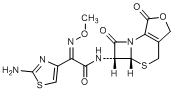
B. (2Z)-2-(2-amino-1,3-thiazol-4-yl)-N-[(5aR,6R)-1,7-dioxo-1,3,4,5a,6,7-hexahydroazeto[2,1-b]furo[3,4-d][1,3]thiazin-6-yl]-2-(methoxyimino)acetamide (deacetylcefotaxime lactone)
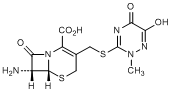
C. (6R,7R)-7-amino-3-{[(6-hydroxy-2-methyl-5-oxo-2,5-dihydro-1,2,4-triazin-3-yl)sulfanyl]methyl}-8-oxo-5-thia-1-azabicyclo[4.2.0]oct-2-ene-2-carboxylic acid (deacyl ceftriaxone)
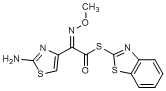
D. S-1,3-benzothiazol-2-yl (2Z)-(2-amino-1,3-thiazol-4-yl)(methoxyimino)ethanethioate
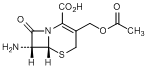
E. (6R,7R)-7-amino-3-[(acetyloxy)methyl]-8-oxo-5-thia-1-azabicyclo[4.2.0]oct-2-ene-2-carboxylic acid (7-aminocephalosporanic acid)

F. 2-methyl-3-sulfanyl-1,2-dihydro-1,2,4-triazine-5,6-dione
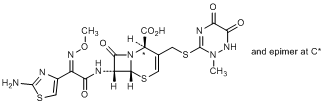
G. (6R,7R)-7-[(2E)-2-(2-amino-1,3-thiazol-4-yl)-2-(methoxyimino)acetamido]-3-{[(2-methyl-6-oxido-5-oxo-2,5-dihydro-1,2,4-triazin-3-yl)sulfanyl]methyl}-8-oxo-5-thia-1-azabicyclo[4.2.0]oct-3-ene-2-carboxylic acid (ceftriaxone 3-ene isomers)
 |  |