Monographs: Pharmaceutical substances: Chlorobutanol (Chlorobutanolum)
Chlorobutanol, anhydrous
Chlorobutanol hemihydrate
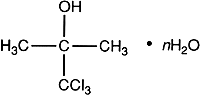
n = 0 (anhydrous)
n = 1/2 (hemihydrate)
C4H7Cl3O (anhydrous)
C4H7Cl3O,1/2H2O (hemihydrate)
Relative molecular mass. 177.5 (anhydrous); 186.5 (hemihydrate).
Chemical name. 1,1,1-Trichloro-2-methyl-2-propanol; CAS Reg. No. 57-15-8 (anhydrous).
1,1,1-Trichloro-2-methyl-2-propanol hemihydrate; CAS Reg. No. 6001-64-5 (hemihydrate).
Description. Colourless crystals or a white, crystalline powder; odour, characteristic, camphoraceous.
Solubility. Slightly soluble in water; very soluble in ethanol (~750 g/l) TS and ether R; soluble in glycerol R.
Category. Antimicrobial preservative.
Storage. Chlorobutanol should be kept in a tightly closed container.
Labelling. The designation on the container of Chlorobutanol should state whether it is the hemihydrate or the anhydrous form.
Additional information. Anhydrous Chlorobutanol melts at about 95 °C and Chlorobutanol hemihydrate melts at about 77 °C, both determined without previous drying.
Requirements
Chlorobutanol contains not less than 98.0% and not more than the equivalent of 101.0% of C4H7Cl3O, calculated with reference to the anhydrous substance.
Identity tests
A. Shake 20 mg with 3 mL of sodium hydroxide (1 mol/l) VS, add 5 mL of water, then slowly add 2 mL of iodine TS; iodoform, perceptible by its odour, is produced and a yellowish precipitate is formed.
B. To 20 mg add 1 mL of pyridine R and 2 mL of sodium hydroxide (~400 g/l) TS. Heat in a water-bath and shake. Allow to stand; the pyridine layer becomes red.
Solution in ethanol. A solution of 5 g in 10 mL of ethanol (~750 g/L) TS is not more opalescent than opalescence standard TS2 and not more intensely coloured than standard colour solution Yw3 when compared as described under 1.11.1 Colour of liquids.
Sulfated ash. Not more than 1.0 mg/g.
Water. Determine as described under 2.8 Determination of water by the Karl Fischer method, Method A. For the anhydrous form, use 2 g; the water content is not more than 10 mg/g. For the hemihydrate, use 0.3 g; the water content is not less than 45 mg/g and not more than 60 mg/g.
Acidity. Dissolve 2 g in 20 mL of ethanol (~750 g/l) TS and titrate with sodium hydroxide (0.01 mol/l) VS, using 0.1 mL of bromothymol blue/ethanol TS as indicator; not more than 1.0 mL is required to produce a blue colour.
Assay. Dissolve about 0.1 g, accurately weighed, in 20 mL of ethanol (~750 g/l) TS, add 10 mL of sodium hydroxide (~80 g/l) TS, heat in a water-bath for 5 minutes, and cool. Add 20 mL of nitric acid (~130 g/l) TS, 25.0 mL of silver nitrate (0.1 mol/l) VS, and 2 mL of dibutyl phthalate R, and shake vigorously. Add 2 mL of ferric ammonium sulfate (45 g/l) TS and titrate with ammonium thiocyanate (0.1 mol/l) VS until an orange colour is obtained. Repeat the procedure without the Chlorobutanol being examined and make any necessary corrections.
Each mL of silver nitrate (0.1 mol/l) VS is equivalent to 5.916 mg of C4H7Cl3O.
 |  |