Monographs: Pharmaceutical substances: Ciclosporin (Ciclosporinum)
Molecular formula. C62H111N11O12
Relative molecular mass. 1203
Graphic formula
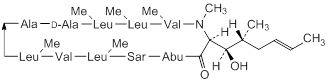
Chemical names.
Cyclo{L-alanyl-D-alanyl-N-methyl-L-leucyl-N-methyl-L-leucyl-N-methyl-L-valyl-[(2S,3R,4R,6E)-3-hydroxy-4-methyl-2-(methylamino)oct-6-enoyl]-l-2-aminobutanoyl-N-methylglycyl-N-methyl-L-leucyl-L-valyl-N-methyl-L-leucyl} (IUPAC); Cyclo[L-alanyl-D-alanyl-N-methyl-L-leucyl-N-methyl-L-leucyl-N-methyl-L-valyl-(3 R,4R,6E)-6,7-didehydro-3-hydroxy-N,4-dimethyl-l-2-aminooctanoyl-l-2-aminobutanoyl-N-methylglycyl-N-methyl-L-leucyl-L-valyl-N-methyl-L-leucyl] ( CAS); CAS Reg. No. 59865-13-3.
Other name. Cyclosporin.
Description. A white or almost white powder.
Solubility. Practically insoluble in water; freely soluble in dehydrated ethanol R and dichloromethane R.
Category. Immunosuppressant.
Storage. Ciclosporin should be kept in a well-closed container, protected from light.
Additional information. Ciclosporin is a product derived from a fermentation process or obtained by other ways.
Requirements
Definition. Ciclosporin contains not less than 97.0% and not more than102.0% of C62H111N11O12, calculated with reference to the dried substance.
Identity tests
• Either test A alone or tests B and C may be applied.
A. Carry out the examination as described under 1.7 Spectrophotometry in the infrared region. The infrared absorption spectrum is concordant with the spectrum obtained from ciclosporin RS or with the reference spectrum of ciclosporin.
B. Carry out as described under 1.14.1 Chromatography, High-performance liquid chromatography using the conditions given under "Assay". The retention time of the principal peak in the chromatogram obtained with solution (1) corresponds to the retention time of the peak due to ciclosporin in the chromatogram obtained with solution (2).
C. Dissolve 5 mg in 5 mL of methanol R, and 1 drop of potassium permanganate (10 g/L) TS and allow to stand; the blue-red colour is gradually discharged.
Specific optical rotation. Use a solution of 5.0 mg of the test substance per mL in methanol R;  = -193 to -185 with reference to the dried substance.
Heavy metals. Use 1.0 g of the test substance for the preparation of the test solution as described under 2.2.3 Limit test for heavy metals, Procedure 3; determine the heavy metals content according to Method A; not more than 20 μg/g.
Clarity and colour of solution in ethanol. A solution of 1.5 g in 15 mL of ethanol (~750 g/L) TS is clear and not more intensely coloured than standard colour solution Y5, BY5 or R7 when compared as described under 1.11.1 Colour of liquids.
Sulfated ash (2.3). Not more than 1.0 mg/g.
Loss on drying. Dry 1.000 g of the test substance at 60 °C under reduced pressure (not exceeding 15 Pa) for 3 hours; it loses not more than 20 mg/g.
Related substances. Carry out the test as described below under "Assay".
Use solution (1) and (3) as described under “Assay”. For solution (2) dilute 2.0 mL of solution (1) to 200 mL using as the diluent a mixture of equal volumes of acetonitrile R and water R.
Inject 20 μL of solution (3). The test is not valid unless the peak-to-valley ratio (Hp/Hv) is at least 1.4, where Hp is the height above the baseline of the peak due to ciclosporin U and Hv is the height above the baseline of the lowest point of the curve separating this peak from the peak due to ciclosporin (retention time 25 to 30 minutes).
Inject alternately 20 μL each of solutions (1) and (2). Record the chromatograms for 1.7 times the retention time of the principal peak.
In the chromatogram obtained with solution (1):
· the area of any impurity peak, is not greater than 0.7 times the area of the peak due to ciclosporin in the chromatogram obtained with solution (2) (0.7%),
· the sum of the areas of all impurities is not greater than 1.5 times the area of the peak due to ciclosporin in the chromatogram obtained with solution (2) (1.5%). Disregard any peak with an area less than 0.05 times the area of the peak due to ciclosporin in the chromatogram obtained with solution (2) (0.05%).
Assay. Determine as described under 1.14.1 Chromatography, High-performance liquid chromatography using a stainless steel column (25 cm × 4 mm) packed with particles of silica gel, the surface of which has been modified with chemically-bonded octadecylsilyl groups (3–5 μm). The column is connected to the injection port by a steel capillary tube about 1 m long with an internal diameter of 0.25 mm. Maintain the temperature of the column and of the steel capillary at 80°C. As the mobile phase use a mixture of water, acetonitrile R, tert-butyl methyl ether R and phosphoric acid (~1440 g/L) TS (52:43:5:0.1 V/V/V/V).
Prepare the following solutions in a mixture of equal volumes of acetonitrile R and water R. For solution (1) dissolve 30.0 mg of the test substance and dilute to 25.0 mL. For solution (2) dissolve 30.0 mg of ciclosporin RS and dilute to 25.0 mL. For solution (3) prepare a solution containing 1.0 mg of ciclosporin for system suitability RS (containing a 100:1 (w/w) mixture of ciclosporin and ciclosporin U) per mL.
Operate with a flow rate of about 1.5 mL per minute. As a detector use an ultraviolet spectrophotometer set at a wavelength of about 210 nm.
Inject 20 μL of solution (3). The assay is not valid unless the peak-to-valley ratio (Hp/Hv) is at least 1.4, where Hp is the height above the baseline of the peak due to ciclosporin U and Hv is the height above the baseline of the lowest point of the curve separating this peak from the peak due to ciclosporin (retention time 25 to 30 minutes).
Inject alternately 20 μL each of solutions (1) and (2). Record the chromatograms for 1.7 times the retention time of the principal peak.
Measure the areas of the peaks corresponding to ciclosporin obtained in the chromatograms and calculate the percentage content of C62H111N11O12, using the declared content of C62H111N11O12 in ciclosporin RS.
Bacterial endotoxins. If intended for use in the manufacture of a parenteral dosage form without a further appropriate procedure for the removal of bacterial endotoxins, carry out the test as described under 3.4 Test for bacterial endotoxins. Dissolve 50 mg of the test substance in a mixture of 280 mg of dehydrated ethanol R and 650 mg of polyoxyethylated castor oil R and dilute to the required concentration using water BET. The test substance contains less than 0.84 IU of endotoxin RS per mg of ciclosporin.
Impurities
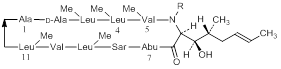
A. various cyclosporins different from ciclosporin (cyclosporine A, R = CH3): cyclosporine B ([7-l-Ala], R = CH3), cyclosporine C ([7-l-Thr], R = CH3), cyclosporine D ([7-l-Val], R = CH3), cyclosporine E ([5-l-Val], R = CH3), cyclosporine G ([7-l-Ape], R = CH3), cyclosporine H ([5-N-methyl-d-Val], R = CH3), cyclosporine L (R = H), cyclosporine T ([4-l-Leu], R = CH3), cyclosporine U ([11-l-Leu], R = CH3) and cyclosporine V ([1-l-Abu], R = CH3)
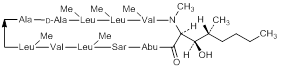
B. [6-[(2S,3R,4R)-3-hydroxy-4-methyl-2-(methylamino)octanoyl]]cyclosporine A,
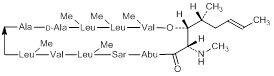
C. [(2S,3R,4R,6E)-3-hydroxy-4-methyl-2-(methylamino)oct-6-enoyl]-l-2-aminobutanoyl-N-methylglycyl-N-methyl-l-leucyl-l-valyl-N-methyl-l-leucyl-l-alanyl-d-alanyl-N-methyl-l-leucyl-N-methyl-l-leucyl-N-methyl-l-valine cyclic-11-Oβ1-ester.
 |  |