Monographs: Pharmaceutical substances: Clavulanate potassium (Kalii clavulanas)
Molecular formula. C8H8KNO5
Relative molecular mass. 237.3
Graphic formula
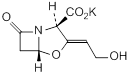
Chemical names. Potassium (2R,3Z,5R)-3-(2-hydroxyethylidene)-7-oxo-4-oxa-1-azabicyclo[3.2.0]heptane-2-carboxylate (1:1) (IUPAC); 4-Oxa-1-azabicyclo[3.2.0]heptane-2-carboxylic acid, 3-(2-hydroxyethylidene)-7-oxo-, potassium salt (1:1), (2R,3Z,5R)- (CAS); CAS Reg. No.61177-45-5.
Description. A white or almost white, crystalline powder.
Solubility. Freely soluble in water R, slightly soluble in ethanol (~710 g/L) TS, very slightly soluble in acetone R.
Category. β-Lactamase inhibitor.
Storage. Clavulanate potassium should be kept in tightly closed containers, protected from light, at a temperature of 2 °C to 8 °C.
Additional information. Clavulanate potassium is hygroscopic.
Requirements
Definition. Clavulanate potassium contains not less than 96.5% and not more than 102.0% of C8H8KNO5, calculated with reference to the anhydrous substance.
Manufacture. The method of production is validated to demonstrate that the substance, if tested, would comply with the limit of not more than 0.01% for clavam-2-carboxylate using a suitable method.
Identity tests
- Either tests A and C or tests B and C may be applied.
A. Carry out the examination as described under 1.7 Spectrophotometry in the infrared region. The infrared absorption spectrum is concordant with the reference spectrum of clavulanate potassium.
B. Carry out the test as described under 1.14.1 Chromatography, High-performance liquid chromatography using the conditions given under “Assay”. The retention time of the principal peak in the chromatogram obtained from solution (1) corresponds to the retention time of the peak due to clavulanic acid obtained from solution (2).
C. Ignite a small quantity, dissolve the residue in water and filter. Add 2 mL of sodium hydroxide (~80 g/L) TS to the filtrate. It yields the reaction described under 2.1 General identification tests, as characteristic of potassium.
Solution S. Dissolve 0.400 g of the test substance in carbon-dioxide-free water R and dilute to 20.0 mL with the same solvent.
pH value (1.13). Dilute 5 mL of solution S to 10 mL with carbon dioxide-free water R; the value lies between 5.5 to 8.0.
Specific optical rotation (1.4). Use solution S;  = + 53 to + 63 with reference to the anhydrous substance.
Polymeric impurities and other impurities absorbing at 278 nm
Prepare fresh solutions and perform the test without delay.
Dissolve 50.0 mg of the test substance in phosphate buffer, pH 7.0 (0.1 mol/L) TS and dilute to 50.0 mL with the same buffer solution. Measure the absorbance immediately. The absorbance (1.6) of the solution determined at 278 nm is not greater than 0.40.
Water. Determine as described under 2.8 Determination of water by the Karl Fischer method, method A, using 0.50 g of the substance; the water content is not more than 5 mg/g.
Related substances. Carry out the test as described under 1.14.1 Chromatography, High-performance liquid chromatography using a stainless steel column (10 cm × 4.6 mm) packed with particles of silica gel, the surface of which has been modified with chemically-bonded octadecylsilyl groups (5 µm).
Prepare the following phosphate buffer, pH 4.0. Dissolve 7.8 g of sodium dihydrogen phosphate R in about 800 mL of water R, adjust to pH 4.0 with phosphoric acid (~105 g/L) TS and dilute to 1000.0 mL with water R.
Use the following conditions for gradient elution:
mobile phase A: phosphate buffer, pH 4.0;
mobile phase B: a mixture of equal volumes of methanol R and mobile phase A.
|
Time (minutes) |
Mobile phase A (% v/v) |
Mobile phase B (% v/v) |
Comments |
|
0–4 |
100 |
0 |
Isocratic |
|
4–15 |
100 to 50 |
0 to 50 |
Linear gradient |
|
15–18 |
50 |
50 |
Isocratic |
|
18–19 |
50 to 100 |
50 to 0 |
Return to initial composition |
|
19–30 |
100 |
0 |
Re-equilibration |
Operate with a flow rate of 1 mL per minute. As a detector use an ultraviolet spectrophotometer set at a wavelength of 230 nm. Maintain the column temperature at 40 °C.
Prepare the following solutions immediately before use in mobile phase A. For solution (1) dissolve about 250 mg of the test substance and dilute to 25.0 mL. For solution (2) dilute 1.0 mL of solution (1) to 100.0 mL. For solution (3) dissolve 10 mg of lithium clavulanate R and 10 mg of amoxicillin trihydrate R and dilute to 100 mL.
Inject 20 µL of solution (3). The test is not valid unless in the chromatogram obtained the resolution between the peaks due to clavulanic acid (retention time about 6 minutes) and the peak due to amoxicillin (with a relative retention of about 1.6 is at least 13.
Inject alternately 20 μL each of solution (1) and (2).
In the chromatogram obtained with solution (1) the following impurities, if present, are eluted at the following relative retentions with reference to clavulanic acid (retention time about 3 minutes): impurity E about 2.3; impurity G about 3.6.
In the chromatogram obtained with solution (1):
- the area of any peak corresponding to either impurity E or impurity G is not greater than the area of the peak due to clavulanic acid in the chromatogram obtained with solution (2) (1.0%);
- the area of any other impurity peak is not greater than 0.2 times the area of the peak due to clavulanic acid in the chromatogram obtained with solution (2) (0.2%);
- the sum of the areas of all impurity peaks is not greater than 2 times the area of the peak due to clavulanic acid in the chromatogram obtained with solution (2) (2.0%). Disregard any peak with an area less than 0.05 times the area of the peak due to clavulanic acid in the chromatogram obtained with solution (2) (0.05%).
Aliphatic amines. The method can be used to determine the following aliphatic amines: 2-methylpropan-2-amine (impurity H); N,N,N',N'-tetramethylethane-1,2-diamine (impurity J); 2,4,4,trimethylpentan-2-amine (impurity K); N,N'-bis(propan-2-yl)ethane-1,2-diamine (impurity L); N,N,N',N'-tetramethyl-2,2'-oxybis(ethaneamine) (impurity M).
Carry out the test as described under 1.14.1 Chromatography, Gas chromatography. Use a fused-silica capillary column, 50 meter long and 0.53 mm in internal diameter, coated with poly(dimethyl)(diphenyl) siloxane R (film thickness: 5 µm).
As an internal standard use a solution containing 0.5 µL of 3-methylpentane-2-one R per mL of water R. For solution (1) transfer 1.00 g of the test substance to a centrifuge tube. Add 5.0 mL of the internal standard solution, 5.0 mL of sodium hydroxide (~80 g/L) TS, 10.0 mL of water R, 5.0 mL of 2-methylpropanol R and 5 g of sodium chloride R. Shake vigorously for 1 minute. Centrifuge to separate the layers and use the upper layer. For solution (2) dissolve 80.0 mg of each of the following amines: 2-methylpropan-2-amine R; N,N,N',N'-tetramethylethane-1,2-diamine R; 2,4,4,trimethylpentan-2-amine R; N,N'-bis(propan-2-yl)ethane-1,2-diamine R and N,N,N',N'-tetramethyl-2,2'-oxybis(ethaneamine) R in hydrochloric acid (~70 g/L) TS and dilute to 200.0 mL with the same acid. Transfer 5.0 mL of this solution into a centrifuge tube. Add 5.0 mL of the internal standard solution, 10.0 mL of sodium hydroxide (~80 g/L) TS, 5.0 mL of 2-methylpropanol R and 5 g of sodium chloride R. Shake vigorously for 1 minute. Centrifuge to separate the layers and use the upper layer.
As a detector use a flame ionization detector.
Use nitrogen R as the carrier gas at an appropriate pressure and a split ratio 1:10 with a flow rate of about 6 mL/min.
Maintain the temperature of the column at 35 °C for 7 minutes, then raise the temperature at a rate of 30 °C per minutes to 150 °C and maintain the temperature for 15 minutes. Keep the temperature of the injection port at 200 °C and that of the flame ionization detector at 250 °C.
Inject alternately 1 µL of solution (1) and solution (2).
In the chromatogram obtained with solution (1) the following impurities, if present, are eluted at the following relative retentions with reference to 3-methylpentane-2-one (internal standard, retention time about 11.4 minutes): impurity H about 0.55; impurity J about 1.07; impurity K about 1.13; impurity L about 1.33; impurity M about 1.57.
Measure the peak responses of the aliphatic amines and of the internal standard. Calculate the percentage content of each impurity using the ratios of the responses of the each aliphatic amine to the responses of the internal standard. Use the ratios of the peak responses of the corresponding reagents as a reference. The sum of the percentage contents of all aliphatic amines is less than 0.2%.
2-Ethylhexanoic acid. Carry out the test as described under 1.14.1 Chromatography, Gas chromatography. Use a fused-silica capillary column 10 meter long and 0.53 mm in internal diameter coated with macrogol 20000 2-nitroterephthalate R (film thickness: 1.0 µm).
As an internal standard use a solution containing 1.0 mg 3-cyclohexylpropionic acid R per mL of cyclohexane R. For solution (1) transfer 0.300 g of the test substance to a centrifuge tube. Add 4.0 mL of a 33% (V/V) solution of hydrochloric acid R. Shake vigorously for 1 minute with 1.0 mL of the internal standard solution. Allow the phases to separate (if necessary, centrifuge for a better separation). Use the upper layer. For solution (2) dissolve 75.0 mg of 2-ethylhexanoic acid R in the internal standard solution and dilute to 50.0 mL with the same solution. To 1.0 mL of the solution add 4.0 mL of a 33% (V/V) solution of hydrochloric acid R. Shake vigorously for 1 minute. Allow the phases to separate (if necessary, centrifuge for a better separation). Use the upper layer.
As a detector use a flame ionization detector.
Use nitrogen as the carrier gas at an appropriate pressure with a flow rate of about 6 mL/minute.
Maintain the temperature of the column at 40°C for 2 minutes, then raise the temperature at a rate of 30°C per minutes to 200°C and maintain for 3 minutes. Keep the temperature of the injection port at 200°C and that of the flame ionization detector at 300°C.
Inject alternately 1 µL of solution (1) and solution (2).
The test is not valid unless the resolution between the peaks due to 2-ethylhexanoic acid (first peak) and due to the internal standard is at least 2.0.
Measure the peak responses of 2-ethylhexanoic acid and of the internal standard. Calculate the percentage content of 2-ethylhexanoic acid in the test substance using the ratios of the responses of 2-ethylhexanoic acid to the responses of the internal standard; the content is not more than 0.8%.
Assay. Carry out the test as described under 1.14.1 Chromatography, High-performance liquid chromatography using a stainless steel column (30 cm x 4.6 mm) packed with particles of silica gel, the surface of which has been modified with chemically-bonded octadecylsilyl groups (10 µm).
Prepare the following phosphate buffer, pH 4.0. Dissolve 15 g of sodium dihydrogen phosphate R in about 800 mL of water R, adjust to pH 4.0 with phosphoric acid (~105 g/L) TS and dilute to 1000.0 mL with the same solvent.
As the mobile phase use a mixture of 5 volumes of methanol R and 95 volumes of phosphate buffer, pH 4.0.
Operate with a flow rate of 1 mL per minute. As a detector use an ultraviolet spectrophotometer set at a wavelength of 230 nm.
Prepare the following acetate buffer, pH 6.0. Dissolve 4.1 g of sodium acetate R in about 800 mL of water R, adjust to pH 6.0 with glacial acetic acid R and dilute to 1000.0 mL with the same solvent.
Prepare the following solutions immediately before use, using acetate buffer, pH 6.0 as the solvent. For solution (1) dissolve 50.0 mg of the test substance and dilute to 50.0 mL. For solution (2) dissolve 50.0 mg of lithium clavulanate RS and dilute to 50.0 mL. For solution (3) dissolve 10 mg of amoxicillin trihydrate R in 10 mL of solution (2).
Inject 10 μL of solution (3). The assay is not valid unless the resolution between the peaks due to clavulanic acid (retention time about 5 minutes) and the peak due to amoxicillin (with a relative retention of about 1.8) is at least 3.5.
Measure the areas of the peaks corresponding to clavulanic acid obtained in the chromatograms of solution (1) and (2) and calculate the percentage content of C8H8KNO5, using the declared content of clavulanic acid (C8H9NO5) in lithium clavulanate RS. 1 mg of clavulanic acid (C8H9NO5) is equivalent to 1.191 mg of clavulanate potassium C8H8KNO5.
Impurities
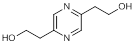
A. 2,2'-(pirazin-2,5-diyl)diethanol (degradation product),
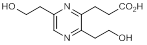
B. 3-[3,6-bis(2-hydroxyethyl)pyrazin-2-yl]propanoic acid (degradation product),
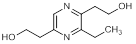
C. 2,2'-(3-ethylpyrazine-2,5-diyl)diethanol (degradation product),

D. 4-(2-hydroxyethyl)-1H-pyrrole-3-carboxylic acid,
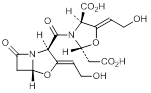
E. (2R,4R,5Z)-2-(carboxymethyl)-5-(2-hydroxyethylidene)-3-[(2R,3Z,5R)-3-(2-hydroxyethylidene)-7-oxo-4-oxa-1-azabicyclo[3.2.0]heptane-2-carbonyl]-1,3-oxazolidine-4-carboxylic acid,
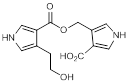
F. 4-({[4-(2-hydroxyethyl)-1H-pyrrole-3-carbonyl]oxy}methyl)-1H-pyrrole-3-carboxylic acid,
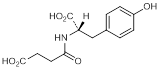
G. 4-{[(1S)-1-carboxy-2-(4-hydroxyphenyl)ethyl]amino}-4-oxobutanoic acid (N-(hydrogenesuccinyl)tyrosine)

H. 2-methylpropan-2-amine (tert-butylamine),
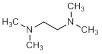
J. N,N,N',N'-tetramethylethane-1,2-diamine (N,N,N',N'-tetramethylethylenediamine),

K. 2,4,4 trimethylpentan-2-amine (1,1,3,3-tetramethylbutylamine),
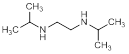
L. N,N'-bis(propan-2-yl)ethane-1,2-diamine (N,N'-diisopropylethylenediamine),
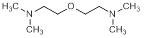
M. N,N,N',N'-tetramethyl-2,2'-oxybis(ethaneamine) (N,N,N',N'-tetramethyl-2,2'-oxybis(ethylene)diamine).
 |  |