Monographs: Pharmaceutical substances: Clindamycin palmitate hydrochloride (Clindamycin palmitas hydrochloridum)
Molecular formula. C34H63ClN2O6S.HCl
Relative molecular mass. 699.9
Graphic formula
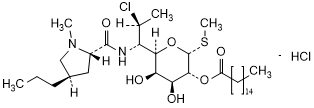
Chemical names. (2R,3R,4S,5R,6R)-6-{(1S,2S)-2-chloro-1-[(2S,4R)-1-methyl-4-propylpyrrolidin-2-carboxamido]propyl}-4,5-dihydroxy-2-(methylsulfanyl)oxan-3-yl hexadecanoate hydrochloride (IUPAC Chem. Org. rules), methyl 7-chloro-6,7,8-trideoxy-2-O-hexadecanoyl-6-[(2S,4R)-1-methyl-4-propylpyrrolidin-2-carboxamido]-1-thio-l-threo-α-d-galacto-octopyranoside, monohydrochloride (IUPAC Carbohydrate rules), l-threo-α-d-galacto-Octopyranoside, methyl 7-chloro-6,7,8-trideoxy-6-[[[(2S,4R)-1-methyl-4-propyl-2-pyrrolidinyl]carbonyl]amino]-1-thio-, 2-hexadecanoate, monohydrochloride (CAS); CAS Reg. No. 25507-04-4.
Description. A white or almost white powder.
Solubility. Freely soluble in dehydrated ethanol R and in dichloromethane R; soluble in water R.
Category. Antibacterial.
Storage. Clindamycin palmitate hydrochloride should be preserved in a tightly closed container.
Additional information. Clindamycin palmitate hydrochloride is a semi-synthetic product derived from a fermentation product.
Requirements
Definition. Clindamycin palmitate hydrochloride contains not less than 91.0% and not more than 102.0% of C34H63ClN2O6S.HCl, calculated with reference to the anhydrous substance.
Identity tests
- Either test A alone or tests B and C may be applied.
A. Carry out the examination as described under 1.7 Spectrophotometry in the infrared region. The infrared absorption spectrum is concordant with the spectrum obtained from clindamycin palmitate hydrochloride RS or with the reference spectrum of clindamycin palmitate hydrochloride.
B. Carry out the test as described under 1.14.1 Chromatography, High-performance liquid chromatography using the conditions given under “Assay”. The retention time of the principal peak in the chromatogram obtained with solution (1) corresponds to that of the peak due to clindamycin palmitate in the chromatogram obtained with solution (2).
C. A solution containing 10 mg of the test substance per mL yields reaction B described under 2.1 General identification tests as characteristic of chlorides.
Water. Determine as described under 2.8 Determination of water by the Karl Fischer method, Method A. Use 0.100 g of the test substance. The water content is not more than 30 mg/g.
pH value (1.13). pH of a solution containing 10 mg of the test substance per mL of carbon-dioxide-free water R, 2.8–3.8.
Sulfated ash (2.3). Not more than 5 mg/g.
Related substances. Carry out the test as described under 1.14.1 Chromatography, High-performance liquid chromatography using a stainless steel column (25 cm × 4.6 mm) packed with particles of silica gel, the surface of which has been modified with chemically-bonded octylsilyl groups (5 μm).
Use the following conditions for gradient elution:
mobile phase A: ammonium acetate (~0.40 g/L) TS - acetonitrile R (50:50);
mobile phase B: acetonitrile R.
|
Time (min) |
Mobile phase A |
Mobile phase B |
Comment |
|
0–30 |
100 to 0 |
0 to 100 |
Linear gradient |
|
30–80 |
0 |
100 |
Isocratic |
|
80–81 |
0 to 100 |
100 to 0 |
Return to initial composition |
|
81–90 |
100 |
0 |
Re-equilibration |
Prepare the following solutions in methanol R. For solution (1) dissolve 100 mg of test substance and dilute to 10.0 mL. For solution (2) dilute 2.0 mL of solution (1) to 100 mL. For solution (3) dissolve 75 mg of clindamycin palmitate hydrochloride RS (containing clindamycin palmitate hydrochloride and impurity A) and dilute to 10.0 mL.
Operate with a flow rate of 1.0 mL per minute. As a detector use an ultraviolet spectrophotometer set at a wavelength of 230 nm.
Inject alternately 20 μL each of solution (1), (2) and (3).
In the chromatogram obtained with solution (3) the retention time of clindamycin palmitate is about 37 minutes. The test is not valid unless the resolution between the peaks due to clindamycin palmitate and impurity A (relative retention about 0.9 with reference to clindamycin palmitate) is at least 3.0.
In the chromatogram obtained with solution (1) the following impurities, if present, are eluted at the following relative retention with reference to clindamycin palmitate: impurity B about 0.8 and impurity A about 0.9.
In the chromatogram obtained with solution (1):
- the area of any impurity peak is not more than the area of the peak due to clindamycin palmitate in the chromatogram obtained with solution (2) (2.0%);
- the sum of the areas of all impurity peaks is not more than 3.5 times the area of the peak due to clindamycin palmitate in the chromatogram obtained with solution (2) (7.0%). Disregard any peak with an area less than 0.025 times the area of the principal peak in the chromatogram obtained with solution (2) (0.05%).
Assay. Carry out the test as described under 1.14.1 Chromatography, High-performance liquid chromatography using a stainless steel column (25 cm × 4.6 mm) packed with particles of silica gel, the surface of which has been modified with chemically-bonded octylsilyl groups (5 μm).
As the mobile phase, use a mixture of 10 volumes of ammonium acetate (~0.40 g/L) TS and 90 volumes of acetonitrile R.
Prepare the following solutions in mobile phase. For solution (1) transfer 50.0 mg of the test substance, into a 50 mL volumetric flask, dissolve and dilute to volume. For solution (2) dissolve 50.0 mg of clindamycin palmitate hydrochloride RS and dilute to 50.0 mL.
Operate with a flow rate of 1.0 mL per minute. As a detector use an ultraviolet spectrophotometer set at a wavelength of 230 nm.
Inject alternately 20 μL each of solutions (1) and (2) and record the chromatograms for 40 minutes.
Measure the areas of the peak responses corresponding to clindamycin palmitate obtained in the chromatograms from solutions (1) and (2) and calculate the percentage content of clindamycin palmitate hydrochloride (C34H63ClN2O6S.HCl), using the declared content of clindamycin palmitate hydrochloride (C34H63ClN2O6S.HCl) in clindamycin palmitate hydrochloride RS.
Impurities
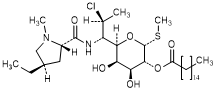
A. (2R,3R,4S,5R,6R)-6-{(1S,2S)-2-chloro-1-[(2S,4R)-4-ethyl-1-methylpyrrolidin-2- carboxamido]propyl}-4,5-dihydroxy-2-(methylsulfanyl)oxan-3-yl hexadecanoate (clindamycin B palmitate) (synthesis-related impurity)
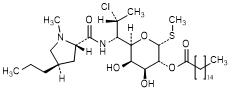
B. (2R,3R,4S,5R,6R)-6-{(1S,2R)-2-chloro-1-[(2S,4R)-1-methyl-4-propylpyrro lidin-2-carboxamido]propyl}-4,5-dihydroxy-2-(methylsulfanyl)oxan-3-yl hexadecanoate (d-erythro-derivative, 7-epi-derivative) (synthesis-related impurity)
 |  |