Monographs: Pharmaceutical substances: Cloxacillin sodium (Cloxacillinum natricum)
Cloxacillin sodium (non-injectable)
Cloxacillin sodium, sterile
Molecular formula. C19H17ClN3NaO5S,H2O.
Relative molecular mass. 475.9
Graphic formula.
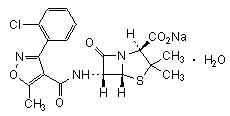
Chemical name
Sodium (2S,5R,6R)-6-({[3-(2-chlorophenyl)-5-methylisoxazol-4-yl]carbonyl}amino)-3,3-dimethyl-7-oxo-4-thia-1-azabicyclo[3.2.0]heptane-2-carboxylate monohydrate; [2S-(2α,5α,6β)]-6-[[[3-(2-chlorophenyl)-5-methyl-4-isoxazolyl]carbonyl]amino]-3,3-dimethyl-7-oxo-4-thia-1-azabicyclo[3.2.0]heptane-2-carboxylic acid, sodium salt, hydrate (1:1:1); 3-(o-chlorophenyl)-5-methyl-4-isoxazolyl penicillin sodium salt monohydrate; CAS Reg. No. 7081-44-9.
Description. A white, crystalline powder; odourless.
Solubility. Soluble in 2.5 parts of water and in 30 parts of ethanol (~750 g/l) TS.
Category. Antibiotic.
Storage. Cloxacillin sodium should be kept in a tightly closed container, protected from light.
Labelling. The designation sterile Cloxacillin sodium indicates that the substance complies with the additional requirements for sterile Cloxacillin sodium and may be used for parenteral administration or for other sterile applications.
Additional information. Cloxacillin sodium is hygroscopic. Even in the absence of light Cloxacillin sodium is gradually degraded on exposure to a humid atmosphere, the decomposition being faster at higher temperatures.
Requirements
Definition. Cloxacillin sodium contains not less than 90.0% of total penicillins calculated as C19H18ClN3O5S, and with reference to the anhydrous substance.
Identity tests
• Either tests A and C or tests B and C may be applied.
A. Carry out the examination as described under 1.7 Spectrophotometry in the infrared region. The infrared absorption spectrum is concordant with the spectrum obtained from cloxacillin sodium RS or with the reference spectrum of cloxacillin sodium.
B. Place 2 mg into a test-tube, add 2 mg of disodium chromotropate R and 2 mL of sulfuric acid (~1760 g/l) TS. Immerse the tube in a suitable bath at 150 °C for 3–4 minutes; a purple colour is produced.
C. Ignite 20 mg and dissolve the residue in acetic acid (~60 g/l) TS. The solution yields reaction B described under 2.1 General identification tests as characteristic of sodium.
Specific optical rotation. Use a 10 mg/mL solution, and calculate with reference to the anhydrous substance;  = +163° to +172°.
Water. Determine as described under 2.8 Determination of water by the Karl Fischer method, Method A, using about 0.25 g of the substance; the water content is not less than 35 mg/g and not more than 45 mg/g.
pH value. pH of a 0.10 g/mL solution in carbon-dioxide-free water R, 5.0–7.0.
Chlorine. Carry out the combustion as the 2.4 Oxygen flask method, but using 0.040 g of the test substance and 20 mL of sodium hydroxide (1 mol/l) VS as the absorbing liquid. When the process is complete add 2.5 mL of nitric acid (~130 g/l) TS, 2.5 mL of water and 20 mL of silver nitrate (0.01 mol/l) VS and titrate with ammonium thiocyanate (0.01 mol/l) VS, using ferric ammonium sulfate (45 g/l) TS as indicator. Repeat the operation without the substance being tested. Each mL of silver nitrate (0.01 mL/l) VS is equivalent to 0.3546 mg of Cl; the chlorine content is 70–75 mg/g.
Assay
Dissolve about 50 mg, accurately weighed, in sufficient water to produce 1000 mL. Transfer two 2.0 mL aliquots of this solution into separate stoppered tubes. To one tube add 10 mL of imidazole/mercuric chloride TS, mix, stopper the tube and place in a water-bath at 60 °C for exactly 25 minutes. Cool the tube rapidly to 20 °C (solution (A)).
To the second tube add 10.0 mL of water and mix (solution (B)).
Without delay measure the absorbance of a 1 cm layer at the maximum at about 343 nm against a solvent cell containing a mixture of 2.0 mL of water and 10.0 mL of imidazole/mercuric chloride TS for solution (A) and water for solution (B).
From the difference between the absorbance of solution (A) and that of solution (B) calculate the amount of C19H17ClN3NaO5S in the substance being tested by comparison with cloxacillin sodium RS, similarly and concurrently examined. In an adequately calibrated spectrophotometer the absorbance of the reference solution should be 0.40 ± 0.02.
Additional Requirements for Cloxacillin Sodium for sterile use
Bacterial endotoxins. Carry out the test as described under 3.4 Test for bacterial endotoxins; contains not more than 0.20 IU of endotoxin RS per mg of cloxacillin.
Sterility. Complies with 3.2 Test for sterility.
 |  |