Monographs: Radiopharmaceuticals: Specific monographs: Technetium (99mTc) mertiatide complex injection (Technetii (99mTc) mertiatidi multiplex injectio)
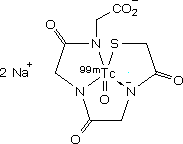
C8H8N3Na2O6S99mTc
Chemical name. Disodium (SP-5-25)-[(sulfido-κS)acetylglycyl-κN-glycyl-κN-glycinato(5-)-κN]oxo[99mTc]technetate(2-) complex.
Other names. (99mTc)-Mercaptoacetyltriglycine complex injection; (99mTc)-MAG3 injection.
Description. Technetium (99mTc) mertiatide complex injection is a clear, colourless aqueous solution.
Technetium-99m has a half-life of 6.02 hours.
Category. Diagnostic.
Storage. Technetium (99mTc) mertiatide complex injection should be kept at a temperature between 2°C to 8°C.
Additional information. Wherever V is used within the tests of this monograph, V is the maximum recommended dose in millilitres.
Requirements
Complies with the monograph for “Parenteral Preparations” and with that for “Radiopharmaceuticals”.
Definition. Technetium (99mTc) mertiatide complex injection is a sterile solution of technetium-99m, complexed with S-benzoylmercaptoacetyltriglycine (betiatide), that is present in excess, to form a mertiatide chelate. The injection is suitable for intravenous administration and contains sufficient sodium chloride to make the solution isotonic with blood. The content of technetium-99m is not less than 90% and not more than 110% of the content of technetium-99m stated on the label at the reference date and time stated on the label. Not less than 94% of the total technetium-99m radioactivity is present as technetium (99mTc) mertiatide complex.
Radionuclide production. Technetium-99m is a radioactive nuclide formed by the radioactive decay of molybdenum-99. Molybdenum-99 is a radioactive isotope of molybdenum and may be produced by neutron irradiation of natural molybdenum or of molybdenum enriched in molybdenum-98 or it may be produced by uranium fission.
Production of radiopharmaceutical preparation. Technetium (99mTc) mertiatide complex injection is prepared aseptically from sterile starting materials such as a sterile kit containing S-benzoylmercaptoacetyltriglycine, a chelating agent such as tartrate, and a stannous salt with sodium pertechnetate (99mTc) injection (fission or non-fission), heated at 100°C for 10 minutes. The injection may have the pH adjusted and may contain reducing, chelating, stabilizing, filling and antioxidizing agents as well as antimicrobial preservatives and buffers. The injection may also be prepared under aseptic processing combined with sterilization by Filtration (see 5.8 Methods of sterilization).
Identity tests
• Either tests A and C or tests B and C may be applied.
A. Record the gamma-ray spectrum using a suitable instrument with a sample of technetium-99m, suitably diluted if needed. The spectrum is concordant with the reference spectrum of a specimen of technetium-99m in that it exhibits a major peak of 140 keV.
Standardized technetium-99m solutions are available from laboratories recognized by the relevant national or regional authority.
B. The half-life determined using a suitable detector system is between 5.72 and 6.32 hours.
C. Examine the radiochromatograms obtained in the test for Radiochemical purity. The distribution of the radioactivity contributes to the identification of the preparation.
pH value. Carry out the test as described in the monograph for “Radiopharmaceuticals”. pH of the injection, 4.0 to 7.5.
Sterility. The injection complies with 3.2 Test for sterility, modified as described in the monograph for “Radiopharmaceuticals”. Test for sterility will be initiated on the day of manufacture. The injection may be released for use before completion of the test.
Bacterial endotoxins. Carry out the test as described under 3.4 Test for bacterial endotoxins, modified as described in the monograph for “Radiopharmaceuticals”. The injection contains not more than 175/V I.U of endotoxins per millilitre. The injection may be released for use before completion of the test.
Radionuclidic purity. Record the gamma-ray spectrum using a suitable instrument and measure the half-life using a suitable method. Determine the relative amounts of technetium-99m and radionuclidic impurities that may be present.
Radiochemical purity. Carry out the test as described under 1.14.1 Chromatography, Thin-layer chromatography, using silica gel R as the coating substance. Apply to the plate about 5 μl of the injection to be examined, suitably diluted to give an optimum count rate and develop for a distance of 15 cm with a mixture of 45 volumes of methanol R, 55 volumes of 9 g/L solution of sodium chloride R and 1 volume of acetic acid. Allow the plate to dry in air and determine the radioactivity distribution by a suitable method. In this system, the technetium (99mTc) mertiatide complex has an Rf value of about 0.45 to 0.55, the pertechnetate ion has an Rf value of about 0.9 to 1, and reduced hydrolysed technetium-99m has an Rf value of about 0 to 0.1. Not less than 94% of the total radioactivity is in the spot corresponding to the technetium (99mTc) mertiatide complex.
Radioactivity. Measure the radioactivity as described under R.1.1 Detection and measurement of radioactivity in a suitable calibrated counting equipment by comparison with a standardized technetium-99m solution or by measurement in an instrument calibrated with the aid of such a solution (a good approximation may be obtained using an ionization chamber and employing a standardized solution of cobalt-57 provided that correction for the differences in the radiations emitted are made).
Standardized technetium-99m and cobalt-57 solutions are available from laboratories recognized by the relevant national or regional authority.
Biodistribution. Carry out the test as described under R3.1 Biological distribution using a set of three mice as described. At 1 hour post injection, the following percentages of the injected radioactivity should be found: not less than 80% in the urine, not more than 5% in the kidneys and not less than 1% in the liver.
 |  |