Monographs: Pharmaceutical substances: Codeine phosphate (Codeini phosphas)
Codeine phosphate hemihydrate
Codeine phosphate sesquihydrate
Molecular formula. C18H21NO3,H3PO4,1/2H2O (hemihydrate); C18H21NO3,H3PO4, 11/2H2O (sesquihydrate).
Relative molecular mass. 406.4 (hemihydrate); 424.4 (sesquihydrate).
Graphic formula.
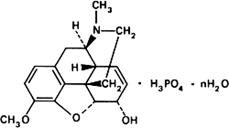
n = 1/2 (hemihydrate)
n = 11/2 (sesquihydrate)
Chemical name. 7,8-Didehydro-4,5α-epoxy-3-methoxy-17-methylmorphinan-6α-ol phosphate (1:1) (salt) hemihydrate; CAS Reg. No. 41444-62-6 (hemihydrate). 7,8-Didehydro-4,5α-epoxy-3-methoxy-17-methylmorphinan-6α-ol phosphate (1:1) (salt) sesquihydrate; CAS Reg. No. 5913-76-8 (sesquihydrate).
Description. Small, colourless crystals or a white, crystalline powder; odourless.
Solubility. Soluble in 4 parts of water; slightly soluble in ethanol (~750 g/l) TS; practically insoluble in ether R.
Category. Antitussive; analgesic.
Storage. Codeine phosphate should be kept in a tightly closed container, protected from light.
Labelling. The designation on the container should state if the Codeine phosphate is the hemihydrate or the sesquihydrate.
Additional information. Codeine phosphate effloresces in dry air.
Requirements
Definition. Codeine phosphate contains not less than 98.0% and not more than 101.0% of C18H21NO3,H3PO4, calculated with reference to the dried substance.
Identity tests
A. Dissolve 5 mg in 1 mL of sulfuric acid (~1760 g/l) TS, add 1 drop of ferric chloride (25 g/l) TS, and warm on a water-bath; a blue colour is produced, which changes to red on the addition of 1 drop of nitric acid (~130 g/l) TS.
B. Dissolve 1 mg in 0.5 mL of selenious acid/sulfuric acid TS; a green colour is produced, which rapidly changes to blue, then slowly to dark yellow-green.
C. Neutralize a 20 mg/mL solution with ammonia (~100 g/l) TS; it yields reaction B described under 2.1 General identification tests as characteristic of orthophosphates.
D. To 5 mL of a 0.2 g/mL solution add 1 mL of ammonia (~100 g/l) TS, cool and scratch the inside of the test-tube to induce crystallization. Wash the precipitate with ethanol (~750 g/l) TS and dry at 105°C. Melting temperature, about 156°C (codeine base).
Specific optical rotation. Use a 20 mg/mL solution and calculate with reference to the dried substance;  = -98° to -102°.
Chlorides. Dissolve 0.70 g in a mixture of 2 mL of nitric acid (~130 g/l) TS and 20 mL of water, and proceed as described under 2.2.1 Limit test for chlorides; the chloride content is not more than 0.35 mg/g.
Sulfates. Dissolve 0.50 g in 20 mL of water and proceed as described under 2.2.2 Limit test for sulfates; the sulfate content is not more than 1 mg/g.
Clarity and colour of solution. A solution of 0.40 g in 10 mL of water is clear and not more intensely coloured than standard colour solution Yw2 when compared as described under 1.11.1 Colour of liquids.
Loss on drying. Dry to constant weight at 105°C: Codeine phosphate (hemihydrate) loses not more than 30 mg/g. Codeine phosphate sesquihydrate loses not less than 50 mg/g and not more than 70 mg/g.
pH value. pH of a 0.04 g/mL solution, 4.2-5.0.
Related alkaloids. Carry out the test as described under 1.14.1 Chromatography, Thin-layer chromatography, using silica gel R1 as the coating substance and a mixture of 72 volumes of ethanol (~750 g/l) TS, 30 volumes of cyclohexane R and 6 volumes of ammonia (~260 g/l) TS as the mobile phase. Apply separately to the plate 10 μl of each of 2 solutions in a mixture of 4 volumes of hydrochloric acid (0.01 mol/l) VS and 1 volume of ethanol (~750 g/l) TS containing (A) 50 mg of the test substance per mL and (B) 0.66 mg of the test substance per mL. After removing the plate from the chromatographic chamber, allow it to dry in air, spray with potassium iodobismuthate TS2, and examine the chromatogram in daylight. Any spot obtained with solution A, other than the principal spot, is not more intense than that obtained with solution B.
Assay. Dissolve about 0.35 g, accurately weighed, in 30 mL of glacial acetic acid R1, and titrate with perchloric acid (0.1 mol/l) VS as described under 2.6 Non-aqueous titration, Method A. Each mL of perchloric acid (0.1 mol/l) VS is equivalent to 39.74 mg of C18H21NO3,H3PO4.
 |  |