Monographs: Pharmaceutical substances: Diethylcarbamazine dihydrogen citrate (Diethylcarbamazini dihydrogenocitras)
Molecular formula. C10H21N3O,C6H8O7 or C16H29N3O8
Relative molecular mass. 391.4
Graphic formula.
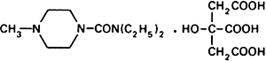
Chemical name. N,N-Diethyl-4-methyl-1-piperazinecarboxamide citrate (1:1); N,N-diethyl-4-methyl-1-piperazinecarboxamide 2-hydroxy-1,2,3-propanetricarboxylate (1:1); CAS Reg. No. 1642-54-2.
Description. A white, crystalline powder; odourless or almost odourless.
Solubility. Very soluble in water; soluble in 35 parts of ethanol (~750 g/l) TS; practically insoluble in ether R.
Category. Filaricide.
Storage. Diethylcarbamazine dihydrogen citrate should be kept in a tightly closed container, protected from light.
Additional information. Diethylcarbamazine dihydrogen citrate is hygroscopic; it has an acid and bitter taste. Even in the absence of light, Diethylcarbamazine dihydrogen citrate is gradually degraded on exposure to a humid atmosphere, the decomposition being faster at higher temperatures.
Requirements
Definition. Diethylcarbamazine dihydrogen citrate contains not less than 98.0% and not more than 101.0% of C10H21N3O,C6H8O7, calculated with reference to the anhydrous substance.
Identity tests
• Either tests A and D or tests B and C may be applied.
A. Dissolve 0.05 g in 25 mL of water. Add 1 mL of sodium hydroxide (~80 g/l) TS and 4 mL of carbon disulfide R, and shake for 2 minutes. Separate the aqueous layer. Centrifuge the lower layer if necessary, and filter through a dry filter, collecting the filtrate in a small flask provided with a glass stopper. Carry out the examination of the filtered solution using carbon disulfide R as the blank as described under 1.7 Spectrophotometry in the infrared region. The infrared absorption spectrum is concordant with the spectrum obtained from diethylcarbamazine dihydrogen citrate RS treated similarly or with the reference spectrum of diethylcarbamazine base.
B. Dissolve 0.5 g in 10 mL of water, add 10 mL of sodium hydroxide (1 mol/l)VS, and extract with 4 successive quantities, each of 5 mL of chloroform R. Retain the aqueous layer for test C. Wash the combined chloroform extracts with water, filter through a plug of cotton wool, and evaporate the chloroform. Add 1 mL of ethyl iodide R to the residue, and heat gently under a reflux condenser for 5 minutes. Cool, separate the viscous yellow oil, and dissolve it in ethanol (~750 g/l) TS. Add, with continuous stirring, sufficient ether R to precipitate the quaternary ammonium salt, and filter. Dissolve the precipitate in ethanol (~750 g/l) TS, reprecipitate with ether R, and dry at 105°C; melting temperature, about 152°C (1-diethylcarbamoyl-4-methylpiperazine ethiodide).
C. The aqueous layer from test B yields reaction B described under 2.1 General identification tests as characteristic of citrates.
D. Melting temperature, after drying at 80°C, about 137°C.
Heavy metals. Use 1.0 g for the preparation of the test solution as described under 2.2.3 Limit test for heavy metals, Procedure 1; determine the heavy metals content according to Method A; not more than 20 μg/g.
Sulfated ash. Not more than 1.0 mg/g.
Water. Determine as described under 2.8 Determination of water by the Karl Fischer method, Method A, using about 1 g of the substance; the water content is not more than 10 mg/g.
pH value. pH of a 30 mg/mL solution, 3.5-4.5.
N -Methylpiperazine. Carry out the test as described under 1.14.1 Chromatography, Thin-layer chromatography, using silica gel R1 as the coating substance and a mixture of 6 volumes of ethanol (~750 g/l) TS, 3 volumes of glacial acetic acid R and 1 volume of water as the mobile phase. Apply separately to the plate 5 μl of each of 2 solutions in methanol R containing (A) 50 mg of the test substance per mL and (B) 0.050 mg of N-methylpiperazine R per mL. After removing the plate from the chromatographic chamber, allow it to dry in air, spray with a mixture of 3 volumes of platinic chloride (60 g/l) TS, 97 volumes of water and 100 volumes of potassium iodide (60 g/l) TS, and examine the chromatogram in daylight. The spot obtained with solution B is more intense than any spot, corresponding in position and appearance, obtained with solution A.
Assay. Dissolve about 0.35 g, accurately weighed, in 30 mL of glacial acetic acid R1, and titrate with perchloric acid (0.1 mol/l) VS as described under 2.6 Non-aqueous titration, Method A. Each mL of perchloric acid (0.1 mol/l) VS is equivalent to 39.14 mg of C10H21N3O,C6H8O7.
 |  |