Monographs: Pharmaceutical substances: Primaquine diphosphate (Primaquini diphosphas)
Molecular formula. C15H21N3O,2H3PO4.
Relative molecular mass. 455.3
Graphic formula.
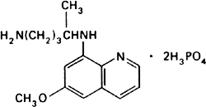
Chemical name. 8-[(4-Amino-1-methylbutyl)amino]-6-methoxyquinoline phosphate (1:2); N4-(6-methoxy-8-quinolinyl)-1,4-pentanediamine phosphate (1:2); CAS Reg. No. 63-45-6.
Description. An orange-red, crystalline powder; odourless or almost odourless.
Solubility. Soluble in water; practically insoluble in ethanol (~750 g/l) TS and ether R.
Category. Antimalarial.
Storage. Primaquine diphosphate should be kept in a well-closed container, protected from light.
Requirements
Definition. Primaquine diphosphate contains not less than 98.0% and not more than 102.0% of C15H21N3O,2H3PO4, calculated with reference to the dried substance.
Identity tests
• Either tests A and C or tests B, C, and D may be applied.
A. Carry out the examination as described under 1.7 Spectrophotometry in the infrared region. The infrared absorption spectrum is concordant with the spectrum obtained from primaquine diphosphate RS or with the reference spectrum of primaquine diphospate.
B. Dissolve 10 mg in 5 mL of water and add 1 mL of ceric ammonium sulfate/nitric acid TS; a deep violet colour is immediately produced (distinction from chloroquine).
C. To 1 mL of a 20 mg/mL solution add 3 mL of nitric acid (~130 g/l) TS; it yields reaction A described under 2.1 General identification tests as characteristic of orthophosphates.
D. Melting temperature, about 202°C.
Loss on drying. Dry to constant weight at 105°C; it loses not more than 10 mg/g.
pH value. pH of a 10 mg/mL solution, 2.5-3.5.
Related substances. Carry out the test as described under 1.14.1 Chromatography, Thin-layer chromatography, using silica gel R1 as the coating substance and a mixture of 3 volumes of dimethylamine/ethanol TS, 4 volumes of acetone R and 5 volumes of chloroform R as the mobile phase. To 5 mL of a solution containing 20 mg of the test substance per mL add 5 mL of chloroform R and 0.5 mL of ammonia (~35 g/l) TS and shake. Separate the chloroform layer, filter and apply 5 μl of this solution to the plate. After removing the plate from the chromatographic chamber, allow it to dry in air, and examine the chromatogram in ultraviolet light (365 nm). Only a single fluorescent spot is obtained.
Assay. Carry out the assay as described under 2.7 Nitrite titration, using about 0.9 g, accurately weighed, and 50 mL of hydrochloric acid (~70 g/l) TS. Each mL of sodium nitrite (0.1 mol/l) VS is equivalent to 45.53 mg of C15H21N3O,2H3PO4.
 |  |