Monographs: Pharmaceutical substances: Suxamethonium chloride (Suxamethonii chloridum)
Molecular formula. C14H30Cl2N2O4,2H2O
Relative molecular mass. 397.3
Graphic formula.
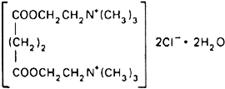
Chemical name. Choline chloride, succinate (2:1), dihydrate; 2,2'-[(1,4-dioxo-1,4-butanediyl)bis(oxy)]bis[N,N,N-trimethylethanaminium] dichloride, dihydrate; 2,2'-succinyldioxybis(ethyltrimethylammonium) dichloride, dihydrate; CAS Reg. No. 6101-15-1 (dihydrate).
Other name. Succinylcholine chloride.
Description. A white or almost white, crystalline powder; odourless or almost odourless.
Solubility. Soluble in 1 pan of water; slightly soluble in ethanol (~750 g/l) TS; practically insoluble in ether R.
Category. Muscle relaxant.
Storage. Suxamethonium chloride should be kept in a tightly closed container, protected from light.
Additional information. Suxamethonium chloride is hygroscopic. Even in the absence of light, it is gradually degraded on exposure to a humid atmosphere, the decomposition being faster at higher temperatures.
Requirements
Definition. Suxamethonium chloride contains not less than 98.0% and not more than 101.0% of C14H30Cl2N2O4, calculated with reference to the anhydrous substance.
Identity tests
A. Dissolve 25 mg in 1 mL of water, add 0.1 mL of cobalt(II) chloride (5 g/l) TS and 0.1 mL of potassium ferrocyanide (45 g/l) TS; an emerald green colour is produced.
B. Dissolve 0.05 g in 10 mL of water, add 10 mL of sulfuric acid (~100 g/l) TS and 30 mL of ammonium reineckate (10 g/l) TS; a pink precipitate is produced. Allow to stand for 30 minutes, filter and wash with water, then with ethanol (~750 g/l) TS and with ether R. Dry the residue at 80°C; melting temperature, about 183°C.
C. A 0.05 g/mL solution yields reaction A described under 2.1 General identification tests as characteristic of chlorides.
Clarity and colour of solution. A solution of 1.0 g in 10 mL of water is clear and colourless.
Sulfated ash. Not more than 1.0 mg/g.
Water. Determine as described under 2.8 Determination of water by the Karl Fischer method, Method A, using about 0.15 g of the substance; not less than 80 mg/g and not more than 100 mg/g.
pH value. pH of a 10 mg/mL solution, 4.0-5.0.
Related substances. Carry out the test as described under 1.14.1 Chromatography, Thin-layer chromatography, using cellulose R2 as the coating substance and a mixture of 4 volumes of 1-butanol R, 1 volume of acetic acid (~300 g/l) TS, and 5 volumes of water as the mobile phase. Apply separately to the plate 10 μl of each of 2 solutions containing (A) 5.0 mg of the test substance per mL and (B) 0.10 mg of the test substance per mL. Develop the plate for 2 hours. After removing the plate from the chromatographic chamber, dry it at 90°C for 15 minutes, allow it to cool, spray it with potassium iodoplatinate TS2 and examine the chromatogram in daylight. Any spot obtained with solution A, other than the principal spot, is not more intense than that obtained with solution B.
Assay. In order to avoid overheating in the reaction medium, mix thoroughly throughout the titration and stop the titration immediately after the end-point has been reached.
Dissolve 0.150 g in 50 mL of acetic anhydride R. Carry out a potentiometric titration using perchloric acid (0.1 mol/L) VS, as described under 2.6 Non-aqueous titration.
1 mL of 0.1 M perchloric acid is equivalent to 18.07 mg of C14H30Cl2N2O4.
Additional requirements for Suxamethonium chloride for parenteral use
Complies with the monograph for "Parenteral preparations".
Bacterial endotoxins. Carry out the test as described under 3.4 Test for bacterial endotoxins; contains not more than 2.0 IU of endotoxin RS per mg.
 |  |