Monographs: Pharmaceutical substances: Chloroquine phosphate (Chloroquini phosphas)
Molecular formula. C18H26ClN3,2H3PO4
Relative molecular mass. 515.9
Graphic formula.
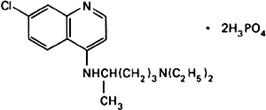
Chemical name. 7-Chloro-4-[[4-(diethylamino)-1-methylbutyl]amino]quinoline phosphate (1:2); N4-(7-chloro-4-quinolinyl)-N1,N1-diethyl-1,4-pentanediamine phosphate (1:2); CAS Reg. No. 50-63-5.
Description. A white or almost white, crystalline powder: odourless or almost odourless.
Solubility. Soluble in 4 parts of water; very slightly soluble in ethanol (~750 g/l) TS and ether R.
Category. Antimalarial; antiamoebic.
Storage. Chloroquine phosphate should be kept in a well-closed container, protected from light.
Additional information. Chloroquine phosphate has a bitter taste; it is slowly discoloured by light. Chloroquine phosphate may exist in 2 polymorphic forms differing in melting temperature, one of which melts at about 194°C, the other at about 215°C; mixtures of the 2 forms melt between 194°C and 215°C.
Requirements
Definition. Chloroquine phosphate contains not less than 98.0% and not more than 101.0% of C18H26ClN3,2H3PO4, calculated with reference to the dried substance.
Identity tests
A. The absorption spectrum (1.6) of a 10 μg/mL solution in hydrochloric acid (0.01 mol/l) VS, when observed between 240 nm and 360 nm, exhibits 3 maxima at about 257 nm, 329 nm, and 343 nm. The absorbances at those wavelengths are about 0.29, 0.32, and 0.37, respectively (preferably use 2-cm cells for the measurements and calculate the absorbances of 1-cm layers). The ratio of the absorbance of a 1-cm layer at 257 nm to that at 343 nm is between 0.77 and 0.85, and the ratio of the absorbance at 329 nm to that at 343 nm is between 0.86 and 0.95.
B. To 1 mL of a 20 mg/mL solution add 3 mL of nitric acid (~130 g/l) TS; yields reaction A described under 2.1 General identification tests as characteristic of orthophosphates.
C. To a solution of 0.05 g in 20 mL of water R add 5 mL of trinitrophenol (7 g/l) TS. Filter, wash the precipitate with water R until the filtrate is colourless, and dry the precipitate over silica gel, desiccant, R. Melting temperature, about 207°C (picrate).
Loss on drying. Dry to constant weight at 105°C; it loses not more than 20 mg/g.
pH value (1.13). pH of a 0.10 g/mL solution, 3.5-4.5.
Related substances. Carry out the test as described under 1.14.1 Chromatography, Thin-layer chromatography, using silica gel R2 as the coating substance and a mixture of 5 volumes of chloroform R, 4 volumes of cyclohexane R, and 1 volume of diethylamine R as the mobile phase. Apply separately to the plate 5 μl of each of 3 solutions containing (A) 40 mg of the test substance per mL, (B) 0.40 mg of the test substance per mL and (C) 0.20 mg of the test substance per mL. After removing the plate from the chromatographic chamber, allow it to dry in air, and examine the chromatogram in ultraviolet light (254 nm).
Any spot in the chromatogram obtained with solution A, other than the principal spot, is not more intense than that in the chromatogram obtained with solution B (1.0%) and not more than one such spot is more intense than that in the chromatogram obtained with solution C (0.5%).
Assay. Dissolve about 0.23 g, accurately weighed, in 20 mL of glacial acetic acid R1 with the aid of heat (preferably heat under reflux condenser), cool and add 20 mL of dioxan R. Titrate with perchloric acid (0.1 mol/l) VS as described under 2.6 Non-aqueous titration, Method A. Each mL of perchloric acid (0.1 mol/l) VS is equivalent to 25.79 mg of C18H26ClN3,2H3PO4.
Additional requirement for Chloroquine phosphate for parenteral use
Complies with the monograph for "Parenteral preparations".
 |  |