Monographs: Radiopharmaceuticals: Specific monographs: Iobenguane (123I) injection (Iobenguani (123I) injectio)
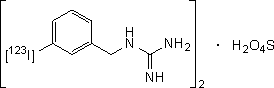
C8H10123IN3
Chemical names. [(3-[123I]iodophenyl)methyl]biguanide.
Other names. m-Iodobenzylguanidine (123I) injection; (123I)-MIBG injection.
Description. Iobenguane (123I ) injection is a clear, colourless or slightly yellow aqueous solution.
Iodine-123 has a half-life of 13.2 hours.
Category. Diagnostic.
Storage. Iobenguane (123I ) injection should be kept at a temperature between 2°C to 8°C, protected from light and during transportation, at a temperature below -10°C.
After aseptic withdrawal of the first dose from a multidose container, the container should be stored at a temperature between 2°C to 8°C and the contents used within 7 days.
Labelling. Specify radioactivity of iodine-123 in Becquerel (or Curie) per gram of iobenguane base.
State the date of withdrawal of the first dose for multidose containers.
Additional information. Wherever V is used within the tests of this monograph, V is the maximum recommended dose, in millilitres.
Requirements
Complies with the monograph for “Parenteral Preparations” and with that for “Radiopharmaceuticals”.
Definition. Iobenguane (123I) injection is a sterile aqueous solution of iodine-123 in the form of m-iodobenzylguanidine sulfate, suitable for intravenous administration and that contains sufficient sodium chloride to make the solution isotonic with blood. A small percentage of the molecules of m-iodobenzylguanidine will contain iodine-123 in place of non-radioactive iodine. The injection contains not less than 90% and not more than 110% of the content of iodine-123 stated on the label at the reference date and hour stated on the label. Not less than 97% of the total radioactivity is due to iodine-123. Not less than 95% of the total iodine-123 radioactivity is present as iobenguane. The specific radioactivity is not less than 10 GBq (270.3 mCi) of iodine-123 per gram of iobenguane base at the reference date and time stated on the label. Not more than 0.35% of the total radioactivity is due to radionuclides other than iodine-123.
Manufacture
Radionuclide production. Iodine-123 may be obtained by proton irradiation of xenon enriched in xenon-124 (not less than 98%), followed by decay of caesium-123 formed via xenon-123.
Production of radiopharmaceutical preparation. Iobenguane (123I) is generally prepared by exchange labelling and contains iobenguane in the unlabelled form. The injection may contain fillers, preservatives, buffers and stabilizing agents. Iobenguane (123I) injection may be prepared under aseptic processing combined with sterilization by Filtration (see 5.8 Methods of sterilization).
Identity tests
• Either tests A and C or tests B and C may be applied.
A. Record the gamma-ray and X-ray spectrum using a suitable instrument with a sample of iodine-123, suitably diluted if needed. The spectrum is concordant with the reference spectrum of a specimen of iodine-123 in that it exhibits a major peak of 159 keV.
Iodine-124 has a half-life of 4.2 days and a main peak of 603 keV. Iodine-125 has a half-life of 59.4 days and emits X-rays of 27 keV and a photon of 35 keV. Tellurium-121 has a half-life of 19.2 days and mains peaks of 507 and 573 keV.
Standardized iodine-123, iodine-125 and tellurium-121 solutions are available from laboratories recognized by the relevant national or regional authority.
B. The half-life determined using a suitable detector system is between 13 and 15 hours.
C. Examine the radiochromatogram obtained in the test for radiochemical purity. The distribution of the radioactivity contributes to the identification of the preparation.
pH value. Carry out the test as described in the monograph for “Radiopharmaceuticals”. pH of the injection, 3.5 to 8.0
Sterility. The injection complies with 3.2 Test for sterility, modified as described in the monograph for “Radiopharmaceuticals”. Test for sterility will be initiated on the day of manufacture. The injection may be released for use before completion of the test.
Bacterial endotoxins. Carry out the test as described under 3.4 Test for bacterial endotoxins, modified as described in the monograph for “Radiopharmaceuticals”. The injection contains not more than 175/V IU of endotoxins per millilitre. The injection may be released for use before completion of the test.
Radionuclidic purity. Record the gamma-ray and X-ray spectrum using a suitable instrument and measure the half-life using a suitable method. Determine the relative amounts of iodine-125, iodine-123, tellurium-121 and other radionuclidic impurities that may be present. Not less than 97% of the total radioactivity is due to iodine-123. Not more than 0.35% of the total radioactivity is due to other radionuclides such as iodine-125 and tellurium-121. No radionuclide with a longer half-life than iodine-125 is detected. Retain the injection to be examined for a sufficient time to allow the iodine-123 to decrease to a level which permits the detection of radionuclidic impurities.
Radiochemical purity. Carry out the test as described under 1.14.1 Chromatography, High-performance liquid chromatography, using a stainless steel column (25 cm x 4.0 mm) packed with silica gel for chromatography R. As the mobile phase, use a mixture of 1 volume of an 80 g/l solution of ammonium nitrate R, 2 volumes of ammonia (~ 35 g/l) TS and 27 volumes of methanol R.
Operate with a flow rate of 1.0 mL/min. As a detector, use detectors suitable for radioactivity and a spectrophotometer set at a wavelength of 254 nm.
Prepare the following solutions. For solution (1), use the injection to be examined. For solution (2), dissolve 0.100 g of sodium iodide R in the mobile phase and dilute to 100 mL with the mobile phase. For solution (3), dissolve 20.0 mg of iobenguane sulfate R, in 50 mL of the mobile phase and dilute to 100 mL with the mobile phase.
Inject separately 10 μl of solutions (1), (2) and (3).
In the chromatogram obtained with solution (1), not less than 95% of the total radioactivity is in the peak corresponding to iobenguane. Not more than 4% of the total radioactivity corresponding to iodide and not more than 1% of the total radioactivity is found in other peaks.
Radioactivity. Measure the radioactivity as described under R.1.1 Detection and measurement of radioactivity in a suitable calibrated counting equipment by comparison with a standardized iodine-123 solution or by measurement in an instrument calibrated with the aid of such a solution.
Standardized iodine-123 solutions are available from laboratories recognized by the relevant national or regional authority.
 |  |