Monographs: Pharmaceutical substances: Dexamethasone acetate (Dexamethasoni acetas)
Dexamethasone acetate, anhydrous
Dexamethasone acetate monohydrate
Molecular formula. C24H31FO6 (anhydrous); C24H31FO6,H2O (monohydrate).
Relative molecular mass. 434.5 (anhydrous); 452.5 (monohydrate).
Graphic formula.
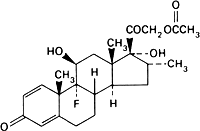
Chemical name. 9-Fluoro-11β,17,21-trihydroxy-16α-methylpregna-1,4-diene-3,20-dione 21-acetate; 21-(acetyloxy)-9-fluoro-11β,17-dihydroxy-16α-methylpregna-1,4-diene-3,20-dione; CAS Reg. No. 1177-87-3 (anhydrous).
9-Fluoro-11β,17,21-trihydroxy-16α-methylpregna-1,4-diene-3,20-dione 21-acetate monohydrate; 21-(acetyloxy)-9-fluoro-11β,17-dihydroxy-16α-methylpregna-1,4-diene-3,20-dione monohydrate; CAS Reg. No. 55812-90-3 (monohydrate).
Description. A white or almost white powder, odourless.
Solubility. Practically insoluble in water; soluble in 40 parts of ethanol (~750 g/l) TS; slightly soluble in ether R.
Category. Adrenoglucocorticoid.
Storage. Dexamethasone acetate should be kept in a tightly closed container, protected from light.
Labelling. The designation on the container of Dexamethasone acetate should state whether the substance is the monohydrate or is in the anhydrous form.
Requirements
Definition. Dexamethasone acetate contains not less than 96.0% and not more than 104.0% of C24H31FO6, calculated with reference to the dried substance.
Identity tests
• Either tests A, B, C and E, or tests B, C, D and E may be applied.
A. Carry out the examination as described under 1.7 Spectrophotometry in the infrared region. For the anhydrous form the infrared absorption spectrum is concordant with the spectrum obtained from dexamethasone acetate RS or with the reference spectrum of dexamethasone acetate. For the monohydrate the infrared absorption spectrum is concordant with the spectrum obtained from dexamethasone acetate monohydrate RS or with the reference spectrum of dexamethasone acetate monohydrate.
B. Dissolve 22 mg in 20 mL of ethanol (~750 g/l) TS and dilute 2 mL to 20 mL with the same solvent. To 2 mL of this solution placed in a stoppered test-tube add 10 mL of phenylhydrazine/sulfuric acid TS, mix, heat in a water-bath at 60°C for 20 minutes and cool immediately. The absorbance of a 1-cm layer at the maximum at about 423 nm is not less than 0.42 (preferably use 2-cm cells for the measurement and calculate the absorbance of a 1-cm layer).
C. See the test described below under "Related steroids". The principal spots obtained with solutions A and C correspond in position with that obtained with solution B. In addition the appearance and intensity of the principal spot obtained with solution A corresponds with that obtained with solution B.
D. Carry out the combustion as described under 2.4 Oxygen flask method, using 7 mg of the test substance and a mixture of 0.5 mL of sodium hydroxide (0.01 mol/l) VS and 20 mL of water as the absorbing liquid. When the process is complete, add 0.1 mL to a mixture of 0.1 mL of freshly prepared sodium alizarinsulfonate (1 g/l) TS and 0.1 mL of zirconyl nitrate TS; the red colour of the solution changes to clear yellow.
E. Heat 0.05 g with 2 mL of potassium hydroxide/ethanol (0.5 mol/l) VS in a water-bath for 5 minutes. Cool, add 2 mL of sulfuric acid (~700 g/l) TS, and boil gently for 1 minute; ethyl acetate, perceptible by its odour (proceed with caution), is produced.
Specific optical rotation. Use a 10 mg/mL solution in dioxan R;  = +82° to +88°.
Sulfated ash. Weigh 0.1 g and use a platinum dish; not more than 5.0 mg/g.
Loss on drying. Dry to constant weight at 100°C under reduced pressure (not exceeding 0.6 kPa or about 5 mm of mercury). For the anhydrous form use about 0.5 g of the substance; it loses not more than 5.0 mg/g. For the monohydrate use about 0.15 g of the substance; it loses not less than 35 mg/g and not more than 45 mg/g.
Related steroids. Carry out the test as described under 1.14.1 Chromatography, Thin-layer chromatography, using silica gel R1 as the coating substance and a mixture of 77 volumes of dichloromethane R, 15 volumes of ether R, 8 volumes of methanol R, and 1.2 volumes of water as the mobile phase. Apply separately to the plate 1 μl of each of 2 solutions in a mixture of 9 volumes of chloroform R and 1 volume of methanol R containing (A) 15 mg of the test substance per mL and (B) 15 mg of dexamethasone acetate RS per mL; also apply to the plate 2 μl of a third solution (C) composed of a mixture of equal volumes of solutions A and B and 1 μl of a fourth solution (D) containing 0.15 mg of the test substance per mL in the same solvent mixture as used for solutions A and B. After removing the plate from the chromatographic chamber, allow it to dry in air until the solvents have evaporated and heat at 105°C for 10 minutes; allow to cool, spray with blue tetrazolium/sodium hydroxide TS, and examine the chromatogram in daylight. Any spot obtained with solution A, other than the principal spot, is not more intense than that obtained with solution D.
Assay
• The solutions must be protected from light throughout the assay.
Dissolve about 20 mg, accurately weighed, in sufficient aldehyde-free ethanol (~750 g/l) TS to produce 100 mL. Dilute 20 mL of this solution with sufficient aldehyde-free ethanol (~750 g/l) TS to produce 100 mL. Transfer 10.0 mL of the diluted solution to a 25-mL volumetric flask, add 2.0 mL of blue tetrazolium/ethanol TS and displace the air with oxygen-free nitrogen R. Immediately add 2.0 mL of tetramethylammonium hydroxide/ethanol TS and again displace the air with oxygen-free nitrogen R. Stopper the flask, mix the contents by gentle swirling and allow to stand for 1 hour in a water-bath at 30°C. Cool rapidly, add sufficient aldehyde-free ethanol (~750 g/l) TS to produce 25 mL, and mix. Measure the absorbance of a 1-cm layer at the maximum at about 525 nm against a solvent cell containing a solution prepared by treating 10 mL of aldehyde-free ethanol (~750 g/l) TS in a similar manner. Calculate the amount of C24H31FO6 in the substance being tested by comparison with dexamethasone acetate RS, similarly and concurrently examined.
 |  |