Monographs: Pharmaceutical substances: Chloramphenicol (Chloramphenicolum)
Molecular formula. C11H12Cl2N2O5
Relative molecular mass. 323.1
Graphic formula.
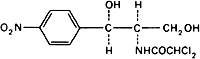
Chloramphenicol
Chemical name. D-threo-(-)-2,2-Dichloro-N-[β-hydroxy-α-(hydroxymethyl)-p-nitrophenethyl]acetamide; [R-(R*,R*)]-2,2-dichloro-N-[2-hydroxy-1-(hydroxymethyl)-2-(4-nitrophenyl)ethyl]acetamide; CAS Reg. No. 56-75-7.
Description. Colourless to greyish white or yellowish white, needle-like crystals or elongated plates or a crystalline powder; odourless.
Solubility. Slightly soluble in water; freely soluble in ethanol (~750 g/l) TS and propylene glycol R; slightly soluble in ether R.
Category. Antibiotic.
Storage. Chloramphenicol should be kept in a well-closed container, protected from light.
Additional information. Chloramphenicol has a bitter taste. A solution in dehydrated ethanol R is dextrorotatory and a solution in ethyl acetate R is levorotatory.
Requirements
Definition. Chloramphenicol contains not less than 97.0% and not more than 102.0% of C11H12Cl2N2O5 calculated with reference to the dried substance.
Identity tests
• Either test A alone or tests B and C may be applied.
A. Carry out the examination as described under 1.7 Spectrophotometry in the infrared region. The infrared absorption spectrum is concordant with the spectrum obtained from chloramphenicol RS or with the reference spectrum of chloramphenicol.
B. See the test described below under "Related substances". The principal spot obtained with solution B corresponds in position, appearance, and intensity with that obtained with solution C.
C. Melting temperature, about 151°C.
Specific optical rotation. Use a 50 mg/mL solution in dehydrated ethanol R;  = +18.5° to +21.5°.
Free chlorides. For the preparation of the test solution shake 0.50 g with 20 mL of water and 10 mL of nitric acid (~130 g/l) TS for 1 minute, filter, and wash the filter with 5 mL of water. Proceed with the filtrate as described under 2.2.1 Limit test for chlorides; the chloride content is not more than 0.5 mg/g.
Solution in ethanol. A solution of 0.50 g in 10 mL of ethanol (~750 g/l) TS is clear.
Sulfated ash. Not more than 1.0 mg/g.
Loss on drying. Dry to constant weight at 105°C; it loses not more than 10 mg/g.
pH value. Shake 0.05 g with 10 mL of carbon-dioxide-free water R; pH of the suspension, 5.0-7.5.
Related substances. Carry out the test as described under 1.14.1 Chromatography, Thin-layer chromatography, using silica gel R2 as the coating substance and a mixture of 9 volumes of chloroform R and 1 volume of methanol R as the mobile phase. Apply separately to the plate 5 μl of each of 3 freshly prepared solutions in ethanol (~750 g/l) TS containing (A) 20 mg of the test substance per mL, (B) 0.20 mg of the test substance per mL, and (C) 0.20 mg of chloramphenicol RS per mL. After removing the plate from the chromatographic chamber, allow it to dry in air until the solvents have evaporated, heat at 105°C for 5 minutes, and examine the chromatogram in ultraviolet light (254 nm). Any spot obtained with solution A, other than the principal spot, is not more intense than that obtained with solution B.
Assay. Dissolve about 20 mg, accurately weighed, in sufficient water to produce 100 mL; dilute 10.0 mL of this solution to 100 mL with the same solvent. Measure the absorbance of a 1-cm layer of the diluted solution at the maximum at about 278 nm. Calculate the amount of C11H12Cl2N2O5 in the substance being tested by comparison with chloramphenicol RS, similarly and concurrently examined. In an adequately calibrated spectrophotometer, the absorbance of the reference solution should be 0.60 ± 0.03.
 |  |