Monographs: Pharmaceutical substances: Chloramphenicol palmitate (Chloramphenicoli palmitas)
Molecular formula. C27H42Cl2N2O6
Relative molecular mass. 561.5
Graphic formula.
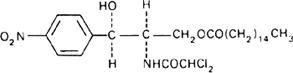
Chemical name. D-threo-(-)-2,2-Dichloro-N-[β-hydroxy-α-(hydroxymethyl)-p-nitrophenethyl]acetamide α-palmitate; [R-(R*,R*)]-2-[(dichloroacetyl)amino]-3-hydroxy-3-(4-nitrophenyl)propyl hexadecanoate; CAS Reg. No. 530-43-8.
Description. A fine, white, unctuous, crystalline powder; odour, faint.
Solubility. Practically insoluble in water; sparingly soluble in ethanol (~750 g/l) TS; soluble in ether R.
Category. Antibacterial drug.
Storage. Chloramphenicol palmitate should be kept in a tightly closed container, protected from light.
Additional information. If Chloramphenicol palmitate is to be used to prepare a dosage form in the solid state, it should contain at least 90% of polymorph B. If a liquid dosage form is to be prepared, e.g., a suspension, the method of preparation should be such as to ensure that at least 90% of the chloramphenicol palmitate is present as polymorph B in the final product.
Requirements
Definition. Chloramphenicol palmitate contains not less than 98.0% and not more than 102.0% of C27H42Cl2N2O6, calculated with reference to the dried substance.
Identity tests
A. Carry out the test as described under 1.14.1 Chromatography, Thin-layer chromatography, using silica gel R4 as the coating substance and a mixture of 9 volumes of chloroform R, 1 volume of methanol R, and 0.1 volume of water as the mobile phase. Apply separately to the plate 10 μl of each of 2 solutions in acetone R containing (A) 10 mg of the test substance per mL and (B) 10 mg of chloramphenicol palmitate RS per mL. After removing the plate from the chromatographic chamber, allow it to dry in air and examine the chromatogram in ultraviolet light (254 nm). The principal spot obtained with solution A corresponds in position, appearance, and intensity with that obtained with solution B.
B. Dissolve 10 mg in 4 mL of ethanol (~750 g/l) TS, add 1.0 mL of sulfuric acid (~100 g/l) TS and 0.05 g of zinc R powder, and allow to stand for 10 minutes. Decant the supernatant liquid or filter if necessary. Cool the resulting solution in ice and add 0.5 mL of sodium nitrite (100 g/l) TS and, after 2 minutes, 1.0 g of urea R, followed by 1.0 mL of 2-naphthol TS1 and 2.0 mL of sodium hydroxide (~400 g/l) TS; a red colour develops. Repeat the test omitting the zinc R powder; no red colour is produced.
Specific optical rotation. Use a 50 mg/mL solution in dehydrated ethanol R;  = +22.5° to +25.5°.
Sulfated ash. Not more than 1.0 mg/g.
Loss on drying. Dry to constant weight at ambient temperature under reduced pressure (not exceeding 0.6 kPa or about 5 mm of mercury) over phosphorus pentoxide R; it loses not more than 5.0 mg/g.
Acidity. Dissolve 1.0 g by warming to 35 °C with 5 mL of a mixture of equal volumes of ethanol (~750 g/l) TS and ether R, previously neutralized to phenolphthalein/ethanol TS. Titrate with sodium hydroxide (0.1 mol/l) VS, using phenolphthalein/ethanol TS as indicator, until, on gentle shaking, a pink colour persists for 30 seconds; not more than 0.4 mL is required.
Free chloramphenicol. Dissolve, with the aid of gentle heat, 1.0 g in 80 mL of xylene R, cool, and extract with 3 quantities, each of 15 mL, of water; discard the xylene and dilute the combined aqueous extracts to 50 mL with water. Extract the solution with 10 mL of carbon tetrachloride R, allow to separate, discard the carbon tetrachloride, and centrifuge a portion of the aqueous solution. Measure the absorbance of the clear supernatant liquid in a 1-cm layer at the maximum at about 278 nm, using as the blank a solution obtained by repeating the procedure without the substance being examined; the absorbance of this blank solution should not exceed 0.05. Calculate the content of free chloramphenicol, using the absorptivity value of 29.8 ( = 298); not more than 0.45 mg/g.
Assay. Dissolve about 0.03 , accurately weighed, in sufficient dehydrated ethanol R to produce 100 mL; dilute 10 mL of this solution to 100 mL with the same solvent. Measure the absorbance of the diluted solution in a 1-cm layer at the maximum at about 271 nm and calculate the content of C27H42Cl2N2O6 using the absorptivity value of 17.8 ( = 178).
 |  |