Monographs: Pharmaceutical substances: Chlorhexidine diacetate (Chlorhexidini diacetas)
Molecular formula. C22H30Cl2N10,2C2H4O2
Relative molecular mass. 625.6
Graphic formula.
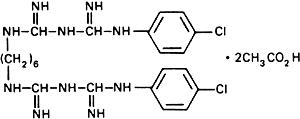
Chemical name. 1,1'-Hexamethylenebis[5-(p-chlorophenyl)biguanide] diacetate; N,N''-bis(4-chlorophenyl)-3,12-diimino-2,4,11,13-tetraazatetradecanediimidamide diacetate; CAS Reg. No. 56-95-1.
Description. A white or yellowish white, microcrystalline powder; odourless or almost odourless.
Solubility. Soluble in 55 parts of water and in 15 parts of ethanol (~750 g/l) TS; very slightly soluble in glycerol R.
Category. Disinfectant.
Storage. Chlorhexidine diacetate should be kept in a well-closed container, protected from light.
Requirements
Definition. Chlorhexidine diacetate contains not less than 97.5% and not more than 101.0% of C22H30Cl2N10,2C2H4O2, calculated with reference to the dried substance.
Identity tests
A. Dissolve 0.1 g in 10 mL of methanol R by warming, and add a mixture of 2 mL of sodium hydroxide (~150 g/l) TS and 2 mL of bromine TS1; a deep red colour is produced.
B. Dissolve 0.1 g in 10 mL of water and add, with shaking, 0.15 mL of copper(II) chloride/ammonia TS; a purple precipitate is produced immediately. Continue to add 0.5 mL of copper(II) chloride/ammonia TS; the colour of the precipitate changes to blue.
C. Heat gently 0.2 g with 1 mL of ethanol (~750 g/l) TS and 1 mL of sulfuric acid (~1760 g/l) TS; ethyl acetate, perceptible by its odour (proceed with caution), is produced.
Sulfated ash. Not more than 2.0 mg/g.
Loss on drying. Dry to constant weight at 105°C; it loses not more than 35 mg/g.
Chloraniline. Dissolve 0.20 g in 30 mL of water. Add with mixing 5 mL of hydrochloric acid (1 mol/L) VS, 1 mL of sodium nitrite (35 g/L) TS, 2 mL of ammonium sulfamate (50 g/L) TS, and shake. Then add 5 mL of freshly prepared N-(1-naphthyl)ethylenediamine hydrochloride(1 g/L)TS, 1 mL of ethanol (~750 g/L) TS, and sufficient water to produce 50 mL. Allow to stand for 30 minutes. Treat similarly 30 mL of a solution containing 0.10 mg of chloraniline R that has been slightly acidified with hydrochloric acid (~70 g/L) TS. The colour produced in the test solution is not more intense than that of the reference solution when compared as described in 1.11.1 Colour of liquids (0.5 mg/g).
Related substances. Carry out the test as described under 1.14.1 Chromatography, Thin-layer chromatography, using silica gel R4 as the coating substance and preparing a slurry as follows: To 8 g of silica gel R4 add 16 mL of water containing 1 g of sodium formate R and coat the plates with a layer 0.5 mm thick. Use a mixture of 50 volumes of chloroform R, 50 volumes of ethanol (~750 g/l) TS and 7 volumes of formic acid (~1080 g/l) TS as the mobile phase. Apply to the plate in the form of a band, 4 cm wide, 20 μl of a solution in acetic acid (~90 g/l) TS containing 72 mg of the test substance per mL (solution A). After removing the plate from the chromatographic chamber, allow it to dry in air and examine the chromatogram in ultraviolet light (254 nm). Score a rectangular area around each group of bands above and below the principal band, quantitatively transfer the enclosed areas of silica gel to a glass-stoppered test-tube, add 5 mL of methanol R, shake for 15 minutes, centrifuge, and measure the absorbance of the clear supernatant liquid in a 1-cm layer at the maximum at about 256 nm. For the blank solution treat in a similar manner equivalent sized areas of silica gel removed from the coating adjacent to the areas previously removed. Prepare solution B in the following manner: Dissolve 0.14 g of the test substance in sufficient acetic acid (~90 g/l) TS to produce 100 mL and dilute 200 μl of this solution to 50 mL with methanol R. The absorbance obtained from the eluted solution A is not greater than the absorbance obtained from solution B.
Assay. Dissolve about 0.45 g, accurately weighed, in 30 mL of glacial acetic acid R1, add 0.15 mL of 1-naphtholbenzein/acetic acid TS as indicator, and titrate with perchloric acid (0.1 mol/l) VS as described under 2.6 Non-aqueous titration, Method A. Each mL of perchloric acid (0.1 mol/l) VS is equivalent to 15.64 mg of C22H30Cl2N10,2C2H4O2.
 |  |