Monographs: Pharmaceutical substances: Dextromethorphan hydrobromide (Dextromethorphani hydrobromidum)
Molecular formula C18H25NO.HBr.H2O
Relative molecular mass. 370.3
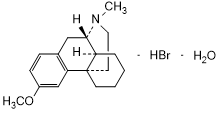
Graphic formula
Chemical name
Monohydrate of ent-3-methoxy-17-methylmorphinan hydrobromide; (9α,13α,14α)-3-methoxy-17-methylmorphinan, hydrobromide, hydrate (1:1:1);
(+)-cis-6-methoxy-11-methyl-1,3,4,9,10,10a-hexahydro-2H-10,4a-(iminoethano)phenanthrene hydrobromide monohydrate; CAS Reg. No. 6700-34-1 (monohydrate).
Description. A white or almost white, crystalline powder.
Solubility. Sparingly soluble in water; freely soluble in ethanol (~750 g/L) TS.
Category. Antitussive.
Storage. Dextromethorphan hydrobromide should be kept in a well-closed container, protected from light.
Requirements
Definition. Dextromethorphan hydrobromide contains not less than 99.0% and not more than 101.0% of C18H25NO,HBr, calculated with reference to the anhydrous substance.
Identity tests
- Either tests A, D and E or tests B, C, D and E may be applied.
A. Dry a small quantity of the test substance for 4 hours under reduced pressure (not exceeding 0.6 kPa or about 5 mm of mercury) over phosphorus pentoxide R and carry out the examination as described under 1.7 Spectrophotometry in the infrared region. The infrared absorption spectrum is concordant with the spectrum obtained from dextromethorphan hydrobromide RS similarly dried or with the reference spectrum of dextromethorphan hydrobromide.
B. The absorption spectrum of a 0.10 mg per mL solution in sodium hydroxide (4 g/L) TS, when observed between 230 nm and 350 nm, exhibits a maximum at 280 nm; the absorbance of a 1 cm layer at this wavelength is about 0.59.
C. Carry out the test as described under 1.14.1 Chromatography, Thin-layer chromatography using silica gel R1 as the coating substance and a freshly prepared mixture of 2 volumes of ammonia (~260 g/L) TS, 10 volumes of dichloromethane R, 13 volumes of methanol R, 20 volumes of ethyl acetate R and 55 volumes of toluene R as the mobile phase. Apply separately to the plate 5 μL of each of the following 2 solutions in methanol R containing (A) 2.5 mg of the test substance per mL and (B) 2.5 mg of dextromethorphan hydrobromide RS per mL. Develop the plate for a distance of about 15 cm. After removing the plate from the chromatographic chamber allow it to dry in air or in a current of air, spray it with potassium iodobismuthate TS3 and examine the chromatogram in daylight. The principal spot obtained with solution (A) corresponds in position, appearance and intensity to that obtained with solution (B).
D. To a 5 mg per mL solution of the test substance in water R add 0.25 mL of nitric acid (~130 g/L) TS; this test yields reaction B described under 2.1 General identification tests as characteristic of bromides.
E. Determine the specific optical rotation (1.4) using a 20 mg per mL solution of the test substance in hydrochloric acid (~3.647 g/L) TS. Calculated with reference to the anhydrous substance; the specific optical rotation is between +28.0° to +30.0°.
Sulfated ash (2.3). Not more than 1.0 mg/g.
Water. Determine as described under 2.8 Determination of water by the Karl Fischer method, method A, using about 0.2 g of the substance; the water content is not less than 46 mg/g and not more than 51 mg/g.
pH value (1.13). Dissolve 0.4 g in carbon-dioxide-free water R using gentle heat, dilute to 20 mL with the same solvent and measure the pH at 20 °C; the value lies between 5.2 and 6.5.
Dimethylaniline. Dissolve 0.5 g in 15 mL of water using gentle heat, cool and add 4 mL of acetic acid (~60 g/L) TS, 1 mL of sodium nitrite (10 g/L) TS and sufficient water to produce 25 mL. Prepare similarly a reference solution containing 5 μg of N,N-dimethylaniline R in 25 mL. The colour produced in the test solution is not more intense than that produced in the reference solution when compared as described under 1.11.1 Colour of liquids; the dimethylaniline content is not more than 10 μg/g.
Impurity E (Levomethorphan). Carry out the test as described under 1.14.1 Chromatography, High-performance liquid chromatography using a stainless steel column (25 cm × 4.6 mm) packed with particles of silica gel coated with cellulose tris(4-methylbenzoate) groups (5 μm). As the mobile phase use a mixture of 940 volumes of n-hexane R, 60 volumes of 2-propanol R and 1 volume of diethylamine R.
Operate with a flow rate of 0.5 mL per minute. As a detector use an ultraviolet spectrophotometer set at a wavelength of 285 nm. Maintain the column at 30 °C.
Prepare the following solutions. For solution (1) transfer about 100 mg of the test substance in a 10.0 mL volumetric flask. Add 4 mL 2-propanol R, sonicate for about 5 minutes, allow to cool at room temperature and make up to volume with mobile phase. For solution (2) dilute 5.0 mL of solution (1) to 100.0 mL with mobile phase. Dilute 2.0 mL of this solution to 100.0 mL with mobile phase. For solution (3) transfer 2 mg of dextromethorphan for system suitability RS (containing a mixture of dextromethorphan and impurity E (levomethorphan)) in a 20.0 mL volumetric flask, add 15 mL of mobile phase, sonicate for about 5 minutes and make up to volume with mobile phase.
Inject 20 µL of solution (3). The test is not valid unless the resolution factor between the peaks due to impurity E (levomethorphan) (retention time about 9 minutes) and dextromethorphan (relative retention of about 1.3) is at least 3.
Inject alternately 20 µL each of solutions (1) and (2).
In the chromatogram obtained with solution (1) the area of any peak corresponding to impurity E (levomethorphan) is not greater than the area of the principal peak in the chromatogram obtained with solution (2) (0.1 %).
Related substances. Carry out the test as described under 1.14.4 High-performance liquid chromatography using a stainless steel column (25 cm × 4.6 mm) packed with particles of silica gel, the surface of which has been modified with chemically-bonded octadecylsilyl groups (5 µm).
As the mobile phase use a solution prepared as follows: dissolve 3.11 g of docusate sodium R in a mixture of 400 mL of water R and 600 mL of acetonitrile R, add 0.56 g of ammonium nitrate R and adjust to apparent pH 2.0 with glacial acid R.
Operate with a flow of 1.0 mL per min. As a detector use an ultraviolet spectrophotometer set at a wavelength of 280 nm.
Prepare the following solutions in mobile phase. For solution (1) use a solution containing 1.0 mg of the test substance per mL. For solution (2) dilute 1.0 mL of solution (1) to 200.0 mL. For solution (3) dissolve 2 mg of dextromethorphan impurity A RS in 2 mL of solution (1) and dilute to 25.0 mL.
Inject 20 µL of solution (3). The test is not valid unless the resolution between the peaks due to dextromethorphan (retention time about 22 minutes) and impurity A (with a relative retention of about 1.1) is at least 1.5.
Inject alternately 20 µL each of solutions (1) and (2). Record the chromatograms for about twice the retention time of dextromethorphan.
In the chromatogram obtained with solution (1) the following impurities, if present, are eluted at the following relative retention with reference to dextromethorphan: impurity B about 0.4; impurity C about 0.8; impurity D about 0.9; impurity F about 0.9 and impurity A about 1.1.
In the chromatogram obtained with solution (1):
‒ the area of any peak corresponding to either impurity A, impurity B or the sum of the areas corresponding to impurity D and F (impurity D and F may co-elute) is not greater than the area of the principal peak obtained with solution (2) (0.5 %);
‒ the area of any peak corresponding to impurity C, when multiplied by a correction factor of 0.2, is not greater than the area of the principal peak obtained with solution (2) (0.5%);
‒ the area or, in case of impurity C, the corrected area of not more than one peak corresponding to either impurity A, impurity B, impurity C, impurity D or impurity F (impurity D and F may co-elute) is greater than 0.5 times the area of the principal peak obtained with solution (2) (0.25 %);
‒ the area of any other peak, other than the principal peak, is not greater than 0.2 times the area of the principal peak obtained with solution (2) (0.10 %);
‒ the sum of the corrected area of any peak corresponding to impurity C and the areas of all other peaks, other than the principal peak, is not greater than twice the area of the principal peak obtained with the solution (2) (1.0 %). Disregard any peak with an area less than 0.1 times the area of the principal peak obtained with solution (2) (0.05%).
Assay
Dissolve about 0.3 g, accurately weighed, in a mixture of 5.0 mL of hydrochloric acid (0.01 mol/L) VS and 20 mL of dehydrated ethanol R. Titrate with sodium hydroxide (0.1 mol/L) VS, determining the end-point potentiometrically. Read the volume added between the 2 points of inflexion. Each mL of sodium hydroxide (0.1 mol/L) VS is equivalent to 35.23 mg of C18H25NO,HBr.
Impurities
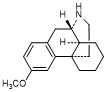
A. ent-3-methoxymorphinan (nordextromethorphan) (degradation product)

B. ent-17-methylmorphinan-3-ol (dextrorphan) (degradation product)
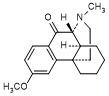
C. ent-3-methoxy-17-methylmorphinan-10-one (degradation product)
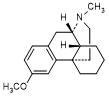
D. ent-3-methoxy-17-methyl-14α-morphinan (14-epi-dextromethorphan)
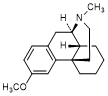
E. 3-methoxy-17-methylmorphinan (levomethorphan) (synthesis product)
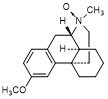
F. (17RS)-ent-3-methoxy-17-methylmorphinan 17-oxide (dextromethorphan N-oxide) (degradation product)
 |  |