Monographs: Pharmaceutical substances: Sodium calcium edetate (Natrii calcii edetas)
Molecular formula. C10H12CaN2Na2O8,2H2O
Relative molecular mass. 410.3
Graphic formula.
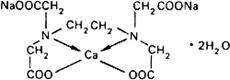
Chemical name. Disodium [(ethylenedinitrilo)tetraacetato]calciate(2-) dihydrate; (OC-6-21)-disodium [[N,N'-1,2-ethanediylbis[N-(carboxymethyl)glycinato]](4-)-N,N',O,O',ON,ON']calciate(2-) dihydrate; calcium chelate of the disodium salt of ethylenediamine-N,N,N',N'-tetraacetic acid dihydrate; CAS Reg. No. 6766-87-6 (dihydrate).
Description. A white or creamy white powder; almost odourless.
Solubility. Soluble in 2 parts of water; very slightly soluble in ethanol (~750 g/l) TS; practically insoluble in in ether R.
Category. Antidote, chelating agent for metals, mainly lead.
Storage. Sodium calcium edetate should be kept in a tightly closed container.
Additional information. Even in the absence of light, Sodium calcium edetate is gradually degraded on exposure to a humid atmosphere, the decomposition being faster at higher temperatures.
Requirements
Definition. Sodium calcium edetate contains not less than 97.0% and not more than 102.0% of C10H12CaN2Na2O8, calculated with reference to the anhydrous substance.
Identity tests
A. Dissolve 2.0 g in 25 mL of water, add 2.0 mL of lead nitrate (100 g/l) TS, shake and add 6 mL of potassium iodide (80 g/l) TS; no yellow precipitate can be observed (keep the solution for test C).
B. To 0.15 mL of ferric chloride (25 g/l) TS add 0.15 mL of ammonium thiocyanate (75 g/l) TS; to this deep red-coloured solution add about 0.05 g of the test substance; the deep red colour changes to yellow.
C. To the solution prepared in test A, add ammonia (~100 g/l) TS, drop by drop, until an alkaline reaction is obtained with pH-indicator paper R. Add 5 mL of ammonium oxalate (25 g/l) TS; a white precipitate is produced (distinction from disodium edetate).
D. When tested for sodium as described under 2.1 General identification tests, yields the characteristic reactions. If reaction B is to be used, ignite a small quantity and dissolve the residue in acetic acid (~60 g/l) TS.
Heavy metals. Use 1.0 g for the preparation of the test solution as described under 2.2.3 Limit test for heavy metals, Procedure 3; determine the heavy metals content according to Method A; not more than 20 μg/g.
Cyanide. Dissolve 1.0 g in 50 mL of water, add 0.1 g of potassium iodide R, 4 mL of ammonia (~100 g/l) TS, and 0.10 mL of silver nitrate (0.01 mol/l) VS, and allow to stand for 1 minute; the opalescence produced is not less than that of a standard solution containing 1 mL of nitric acid (~130 g/l) TS, 1.0 mL of hydrochloric acid (0.0001 mol/l) VS, 9 mL of water, and 0.10 mL of silver nitrate (0.1 mol/l) VS, this solution having also been allowed to stand for 1 minute.
Disodium edetate. Dissolve 5.0 g in 20 mL of water, add 10 mL of ammonia buffer TS2 and 0.2 g of mordant black 11 indicator mixture R, and titrate with magnesium chloride (0.1 mol/l) VS. Not more than 1.5 mL of magnesium chloride (0.1 mol/l) VS is required.
Iron. Ignite 0.5 g and dissolve the residue in 40 mL of water. Treat the solution as described under 2.2.4 Limit test for iron; not more than 80 μg/g.
Water. Determine as described under 2.8 Determination of water by the Karl Fischer method, Method A, using about 0.2 g of the substance; the water content is not more than 130 mg/g.
pH value. pH of a 0.20 g/mL solution in carbon-dioxide-free water R, 6.5-8.0.
Assay. Dissolve about 0.5 g, accurately weighed, in 90 mL of water, add 7 g of methenamine R and 5 mL of hydrochloric acid (~70 g/l) TS. Titrate with lead nitrate (0.05 mol/l) VS, using xylenol orange indicator mixture R. Each mL of lead nitrate (0.05 mol/l) VS is equivalent to 18.71 mg of C10H12CaN2Na2O8.
Additional requirements for Sodium calcium edetate for parenteral use
Complies with the monograph for "Parenteral preparations".
Bacterial endotoxins. Carry out the test as described under 3.4 Test for bacterial endotoxins; contains not more than 0.2 IU of endotoxin RS per mg of sodium edetate.
 |  |