Monographs: Pharmaceutical substances: Cytarabine (Cytarabinum)
Molecular formula. C9H13N3O5
Relative molecular mass. 243.2
Graphic formula.
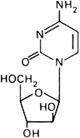
Chemical name. 1-β-D-Arabinofuranosylcytosine; 4-amino-1-β-D-arabinofuranosyl-2(1H)-pyrimidone; CAS Reg. No. 147-94-4.
Description. A white or almost white, crystalline powder; odourless.
Solubility. Freely soluble in water; slightly soluble in ethanol (~750 g/l) TS.
Category. Cytotoxic drug.
Storage. Cytarabine should be kept in a well-closed container.
Additional information. CAUTION: Cytarabine must be handled with care, avoiding contact with the skin and inhalation of airborne particles.
Requirements
Definition. Cytarabine contains not less than 99.0% and not more than 100.5% of C9H13N3O5, calculated with reference to the dried substance.
Identity tests
A. Carry out the examination as described under 1.7 Spectrophotometry in the infrared region. The infrared absorption spectrum is concordant with the spectrum obtained from cytarabine RS or with the reference spectrum of cytarabine.
B. The absorption spectrum of a 10 μg/mL solution in hydrochloric acid (0.1 mol/l) VS, when observed between 230 nm and 350 nm, exhibits a maximum at about 280 nm; the absorbance of a 1-cm layer at this wavelength is about 0.55.
Specific optical rotation. Use a 10 mg/mL solution;  = +154° to +160°.
Sulfated ash. Not more 5.0 mg/g.
Loss on drying. Dry to constant weight at 60 °C under reduced pressure (not exceeding 0.6 kPa or about 5 mm of mercury); it loses not more than 10 mg/g.
Related substances. Carry out the test as described under 1.14.1 Chromatography, Thin-layer chromatography, using silica gel R4 as the coating substance and a mixture of 13 volumes of ethylmethylketone R, 4 volumes of acetone R, and 3 volumes of water as the mobile phase. Apply separately to the plate 5 μl of each of 3 solutions containing (A) 40 mg of the test substance per mL, (B) 0.20 mg of undine R per mL, and (C) 0.20 mg of the test substance per mL. After removing the plate from the chromatographic chamber, allow it to dry in air, and examine the chromatogram in ultraviolet light (254 nm). Any spot obtained with solution A with an Rf value of about 1.1, compared with the spot obtained with solution B, is not more intense than that obtained with solution B. Any other spot obtained with solution A, other than the principal spot, is not more intense than that obtained with solution C.
Assay. Dissolve about 0.5 g, accurately weighed, in 30 mL of glacial acetic acid R1, add 0.15 mL of 1-naphtholbenzein/acetic acid TS as indicator and titrate with perchloric acid (0.1 mol/l) VS as described under 2.6 Non-aqueous titration, Method A. Each mL of perchloric acid (0.1 mol/l) VS is equivalent to 24.32 mg of C9H13N3O5.
 |  |